We haven't yet reached mid-winter by calendar, but bleak is certainly the word for this morning. The sun — if there was sun — would have risen less than five minutes ago at 8:06. The sky is very grey, the air itself looks grey. The time of sunrise will not reverse its course until later this week. On a positive note, sunset is now moving by the minute toward spring, and although the sun is not scheduled to appear any time today, it will set before 4:00 pm for the last time this season. So we remain in shortest day mode for this short week between Christmas and the New Year. England of course celebrates Christmas over two days, but with the 26th of December falling on a Saturday, yesterday was the public holiday, so Bob had a four day weekend — four and a half days if you count in the half day of Christmas Eve — to loaf. And that's pretty much what Christmas is all about for us here. A very English Christmas is eating and watching lots of television. The two-part Cranford was somewhat depressing; and the first part of Dr. Who was a bit incomprehensible, but perhaps the conclusion will explain it all. David Tennant's Hamlet was also a gripper. We skipped the Walk on Boxing Day out of laziness, using the expectation of bad weather as the excuse, but of course that just confirms our un-Englishness. Later, when there were sad reports of an MP dying of a heart attack while on a Boxing Day Walk with his family, we felt vindicated in the wisdom of our laziness.
The UK — and the Continent — has had record cold and snow over the past few weeks. We did have a snowy day with a night in which cars and vans could not get up the snow packed and icy street outside our flat. London was mostly spared the deep snow and transport problems that made holiday travel a nightmare for so many people. Ironically, British Air and Eurostar voted to strike before Christmas making everyone angry until the strikes were called off — then the weather managed to shut both of them down anyway. My Luddite leanings always come out when I see the general public's anger if natural events — like snowstorms — inhibit free movement or access to services. The wonder of technology so quickly turns to entitlement and petulance. Reliance on technological fixes will be the end of civilisation eventually.
Now we must contend with another assault on the globalisation that allowed us to skip off to London without giving a thought to losing easy access to the States. Terrorism and oil prices have made the trips sometimes easier and sometimes harder, both less expensive and more expensive, over the past decade. We had been discussing whether to sacrifice some of Bob's limited vacation days (a limit he has abused a bit over the two-plus years since we became grandparents) to a trip or two that did not involve visiting our children and grandchildren in Massachusetts. We have not yet resolved the Istanbul-versus-Bibs-and-Bobs question, but now this new plane terror threat has been thrown into our faces. Knee-jerk reactions will abound: no potty trips (lets tell the children that one!); no blankies (personally, I have trouble imagining any man, even the most rabid Islamist, reading about third-degree burns in the "groin," and thinking "I could do that"!); and the indignities of the airport searches to come (a political cartoon yesterday has a line of naked passengers boarding a plane!) will make travelling to the States less than pleasant. Huge decreases in the number of passengers has cut the number of flights between Boston and London by half over the last few years. If computers are no longer allowed on board, will that cut the number of business trips? Will fewer passengers lead to even fewer flights with concomitant higher ticket costs? Oh brave new world of the Millennium, you have failed us all — actually we have failed you — but I want to whinge about a world that doesn't let me see my children and grandchildren easily and cheaply.
The children and grandchildren had a grand Christmas from the photos Megan sent through her blog. They had Christmas dinner with Barnz's father and his wife, so the grands (and the son-in-law) were able to celebrate a traditional English Christmas with a turkey and a flaming Christmas pudding. And in the way of children, I see from Megan's Facebook messages, they have all come down with winter ailments immediately following the festivities. Barnz, who is ace at whatever it is he does since he was assiduously courted and interviewed by everyone who knew of his availability after the Microsoft debacle, has a new job, starting this week perhaps, in Providence of all places. So as the world turns, we return to the Providence of our adult youth, and briefly of our children's youth, to continue this chronicle. Fortunately Hingham is on the right side of Boston to make a Providence commute (by train or by car) do-able. Interestingly, a few months ago, in our occasional conversations on where we would go if we returned to the States, Bob and I agreed that Providence would be pretty close to ideal for a life post-London. We did love both our stints in Providence and would never have left if Bob had been able to find a job back in 1983. That was such a painful move, we couldn't bear to return to Providence for the seven years we were in New Jersey, and consequently we lost contact with all our friends from those years. We felt courageous enough to visit Providence in 1991 on our way back from Boston after Bob had had a good job interview, and we believed, correctly, that we would be moving back to New England. We rarely went to Providence during the Hingham years though. I'm never comfortable because for me it is a land of exile.
I guess the idea of moving to Providence for a third time would be at root a way to capture what was lost in 1983, but nothing would match the pain of leaving London. Sometimes we joke about a future of sitting in rockers thinking about what we would be doing if only we lived in London. Yesterday was a very good London day. After a weekend of lethargy, we stirred ourselves into action because we had hot theatre tickets for the evening. After a slow start, in late afternoon we headed off to the Royal Academy to see Wild Thing, a sculpture show of Eric Gill, Jacob Epstein, and Henri Gaudier-Brzeska, three young artists who came together in London in the early 20th century. Just the right size show, with a room devoted to each man. Gill's work is astoundingly beautiful, and remains astoundingly beautiful as you remember this maniacal Roman Catholic nutcase of a man sexually abused his daughters, his sister, and even his dog whilst producing exquisite religious art. Then another excellent supper at Bentley's in Mayfair before heading off to the National Theatre to see the new Alan Bennett play The Habit of Art. The play is a play-within-a-play of an imagined meeting between W.H. Auden and Benjamin Britten in Oxford in 1973. Richard Griffiths plays the actor who plays Auden and Alex Jennings plays the actor who plays Britten. The play-within is possibly the worst play ever with parts written for Auden's mirror and for his easy chair, rhyming on their places in the poet's life. Clever and satiric, the cast and crew are engaged in a shambolic rehearsal of the play-within, while moving deftly between their roles as actors and as characters played, to show us the work that goes into creating art. The strains that arise personally and professionally, the compulsion for an artist to continue to create — the habit of art — and with an emphasis on the shared experience of gay artists, closeted or not.
One of the great gifts of living in London has been the good fortune to learn that drama is an art form that can endlessly remake itself. Before I moved to London, I understood drama to be a static art form: written lines put together by an author and then spoken by actors on a stage, sometimes interesting, often not. I know now that great drama is transcendent: an alternate world is created on the stage, and as a member of the audience, you share the physical space of that alternate world; through the magic of art, you become part of the other, the transcendent world. I vaguely remember learning something like this in a college course on theatre history when we studied the meaning of drama for the ancient Greeks. There is no one way to create the magic that draws the audience in. In His Dark Materials, it was the puppetry; in After Mrs Rochester, it was the physical action of the writhing mad woman; in The Habit of Art, it was the mutiple layers of reality.
Time to look ahead and list those resolutions which are pointless to make because no one ever keeps them according to scientists! Suggestions to help include keeping them positive, keeping them simple, telling all your friends about them, and keeping a diary. Well what's a blog for but using as a diary, so I have one out of four already — and still two days until next year.
Showing posts with label travel. Show all posts
Showing posts with label travel. Show all posts
Tuesday, December 29, 2009

Sunday, October 11, 2009
Norway on my mind
I have only been to Norway once. And only to Oslo.

We went to the Viking Ship Museum.
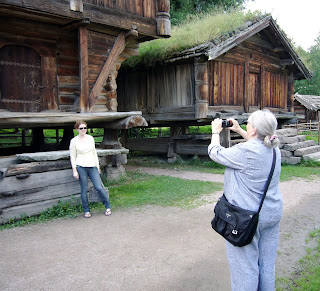
We went to the fantastic open-air architectural museum.

And then we took a ferry to Denmark. (All photos by Bob)
Susan and I also bought a lot of yarn. Our hotel was up the street from the best, most famous handicrafts store in Oslo. How lucky was that. We had to window shop all weekend, waiting until Monday morning when the shop reopened. As we approached, there was a crowd outside that turned out to be the American ladies on the Vogue Knitting Magazine Tour of Scandinavia waiting at the door ahead of us. We were planning a longer trip in Norway the following year, but Bibs was born, and we went to the States instead.
Norway was on my mind on Thursday because Bob and I went to a concert at St John's, Smith Square called Nordic Voices, from Norway. Bob bought the tickets thinking they were a group he listens to on iPod/CD, but when he read the programme, he realised they were some completely different group. Six a capella singers doing Lamentations by Gesualdo and Victoria. Done often. Done well. Nice. And then after the interval they turned to modern pieces by Norwegian composers — Ødegaards, Thoresen, Nystedt, Havrøy (their baritone) — using folk melodies and folk singing voice techniques. An absolutely amazing performance. It was electrifying, and they looked so happy. They thanked us and said this was their first trip to London. Sadly the audience was miniscule. St John's, Smith Square is a much too large Baroque church turned into a concert venue years ago, with terribly uncomfortable chairs and no rise in the floor. Music people we know have a nostalgic fondness for the place, but the concert halls that have opened in the past few years have marginalised St John's, Smith Square. Every established group is deserting them; most of their offerings seem to be posh school music recitals. Audiences are down everywhere, we've noticed. Tickets are an easy item to cut back on when money is short.
Friday morning, Bob called me and said have you seen the news.......no I hadn't, and when I clicked on the New York Times, I was left speechless. A few hours later, Megan called, also speechless. In fact we had a ten minute conversation that was mostly dead air as we communicated speechlessly. She was the first person in the States whose reaction I heard, and I was surprised when she said, Why Does Norway Hate Us? or some variation. Nothing could be further from the truth. I'm not sure Americans realise how much the rest of the world reveres Obama, how much they idealise him. This is a little hard to comprehend in the States, where everyone — the right-wing nuts, the dissatisfied lefties, the press, other politicians — always criticise something Obama has done. There seems to be no question the guy is a loser, with a failed administration, and no backbone. And then there are the people who think he is fascist socialist Nazi, just like Mao, and is appointing czars because he wants to establish a Communist Russian monarchy.
In England, where they can read this stuff, since it's written in English, they have become a bit more cynical — although you wouldn't know it from the days of newspaper coverage on: Why didn't Obama have a one-on-one meeting with Gordon Brown in New York? Why did Gordon have to corner him in a kitchen at the UN for 15 minutes? It can't really be because we tortured his grandfather, can it? The man is a star. Everyone wants to spend their 15 minutes with him. The repulsive Berlusconi shoving Prime Ministers aside, and being upbraided by Queen Elizabeth for his boorishness. The ridiculous Sarkozy organising a 65th D-Day commemoration at the last minute, strong-arming Obama to come, knowing that months earlier Brown had declined participating in such an event, so he wouldn't have to share his rock star guest. And of course the Spanish Prime Minister's Goth daughter(s) — I thought it was hard to tell since the entire family was dressed in black right down to the Prime Minister's tie — with their family holiday photos. None of these people read the swill available to us English readers — most of them could read it, but why would they want to waste their time. What they do know is that the United States had the great good sense to elect a handsome, brilliant, personable, thoughtful, well-educated, caring, accomplished man, who loves his wife and daughters, and who also happens to be a member of a racial/ethnic minority, something which very likely could not happen in whatever country they live in.
However, Norway did not make this award to Obama because he is the biggest rock star on the planet. The motive is much more Manichean: there is Good and there is Evil. The United States by definition is Good, but for eight years, the country turned to the Evil side — and the Peace Prize is a reward for renouncing Evil and turning back to Good. George W. Bush was loathed every where outside the States. He represented every negative trait universally recognised as the stereotype of an American: thick, noisy, bull headed, uncultured, xenophobic, entitled, overly familiar. The first time he became president most accepted it as a terrible mistake; the second time was unforgivable. Electing Obama — and many in Europe commented they should be given the right to vote in US presidential elections because the outcome was so crucial to their lives —was met with relief. The slipping structure of the world had been righted.
Norway is the world's richest real country — discounting Luxembourg which is hardly a country — so they must do a lot of things right (alas, the policy of killing whales is not one of them), so if they want to exert a little power in the unique opportunity given to them of choosing the Nobel Peace Prize winner, what's to say they shouldn't. Most of the criticism heaped on Obama's selection is in the vein of, "but what has he done to deserve this." In fact doing something is not a criteria for the prize laid out in Alfred Nobel's will. Merely acting on the desire to promote peace is acceptable. A BBC Radio-4 presenter made reference to this in a report yesterday mentioning the case of apartheid in South Africa. Nelson Mandela was awarded half the prize in 1993 (nobody ever remembers that F.W. de Clerk was awarded the other half). For 27 years Mandela was imprisoned as a terrorist who regularly refused to denounce violence as a means to end apartheid. When he was released in 1991, and became head of the ANC, he negotiated with de Clerk, but early in 1993, the talks had broken down, and the election that ended apartheid was not held until 1994, several months after the Peace Prize was awarded to the two men. The Prize may have helped to move policy in the direction of peace, and we can all be thankful for the prescience of Norway in taking that step. Norway took a risk on Mandela, and the risk paid off. Don't forget Henry Kissinger was also given a similar half-Nobel — his Vietnamese co-winner turned his half down on the grounds that peace had not yet been achieved — and the war did continue for two years. This too was a case of Norway using the award to influence policy going forward.
So Norway does not hate the US. They may have made Obama's job more difficult with their little surprise. Most commentators seem to believe that. I doubt if that was the Norwegians' intention. No one outside of the US wants Obama to fail, making the world a more dangerous place than it is now. From the slurs I see on the internet, there certainly seems to be a substantial number of Americans who would like nothing better than to see Obama fail. I got this link to Gawker from Megan, and it is incredibly funny, citing things that used to be okay, before Obama did them. Winning the Nobel Peace Prize and getting a puppy for your children head the list. Gawker links to other pieces that I found quite shocking in the level of their vitriol and rudeness. The casual acceptance of vicious behaviour is a danger to the nation, preventing us from working to solve the critical problems that are undermining life in the States.
Tuesday, September 29, 2009
Jenni in Bruges

Our traveling totem Barley sits on a wall in Bruges.
A few weeks ago, Bob and I realised that since Bibs was born 2 years/2 months ago, our holidays have been only to the States except for a week in Germany in 2008 and a weekend in Vienna way back in January. There are many reasons to love living in London, but one of the best is hopping a plane or train and being in Europe in a few hours or less. When we moved here, we coincided with the advent of cheap airlines that would take you any where in Europe for a few pounds (and when they wanted to fill planes, a few pence). The first few years we were here, at the turn of the century, there were at least four discount airlines — Go and Buzz are long gone, Ryanair and Easyjet hang on — competing for passengers by offering lower and lower fares. This was of course in retrospect A Very Bad Thing for many places — Prague and Vilnius were overrun with very drunk Brits attending stag party and hen party weekends – and for some people too — on school holidays very drunk teenage girls were raped and very drunk teenage boys died falling out of hotel windows on Greek islands. And we hardly need to go into the Very Bad Thing this was for airplane emissions and global warming. The cheap airlines are no longer very cheap. The post-9/11 airport security levied stiff taxes on each ticket, the rising price of jet fuel increased fares further, and now we have the endless extra charges for bags, for check-in at the airport, for paying with credit cards, and now for seat reservations too.
For a time though, the cheap airfares were A Very Good Thing for us. Nearly every month I could book a ticket and be in some wonderful city: Amsterdam, Berlin, Stockholm, Helsinki, The Hague, Oslo, Copenhagen, Florence, Rome, Pisa, Dresden, Vienna, Madrid, Barcelona, Siena, Lucca, Brussels, Paris, Nice, Cannes, Monaco, Glasgow, Edinburgh, Munich, Cologne, and Bruges. There are lots of places I still want to see in Europe — Seville, Milan, Bergen, spring to mind — but I have now been to Bruges three times. I have not seen In Bruges yet, but I will watch it tonight because it came in the mail while we were in Bruges.
My trips to Bruges started as literary pilgrimages. I can't remember where I first heard about Dorothy Dunnett, but I bought the first volume at Waterstones in one of those buy two books/get a third one free offer that is now standard in UK bookshops. Of course you can always find two you have been dying to read, but never a third with equal passion. Dorothy Dunnett, who sadly died in 2001 right as I was buying that first volume, is a cult writer with a huge, if hidden, following. She wrote two enormous multi-volume historical fiction series with casts of thousands of characters, both fictional and real, with complicated plots that follow historical events with great accuracy. In 2002, I began the eight volume Niccolo series, and I might have flagged half way through, but by that time, I had told Megan about Dorothy, and she urged me on, as a fan and a fast reader, she finished all eight volumes of Niccolo and then devoured the six volumes of the Lymond chronicle . The heroic Niccolo begins his globe trotting career in the important textile centre of Bruges in Flanders in the Duchy of Burgundy during the 1460s to 1480s. In those pre-Columbian decades, he single-handedly invents international capitalism as he roams through Europe to adventures in Cyprus, Iceland, Africa, and Scotland. By the end of 2002, Megan had convinced me that we must see Bruges for ourselves. So we headed off in cold and raining early November when many places were closed for the public holidays All Saints Day and Armistice Day which serve as a good week to take off after the tourist season is over. But we did have a good time in a lovely cozy hotel, The Egmond which I highly recommend, but it was completely booked for the month when I tried them last week, so plan ahead. We spent a great deal of time eating candy and cross-stitching after finding a very good embroidery shop. 2002 was the end of the year for Bruges as a European Cultural Capital, so there were several special shows still on view about lace and with illuminated manuscripts. And of course we wandered the streets seeking out sites from the Niccolo books where important events happen.

This is the Jerusalem Chapel where Niccolo was married with the approval of the chapel's owner Anselm Adornes who is now entombed in the chapel under this effigy of him and his wife.
The following year, Ryanair decided to fly a route to Ostend/Bruges, so Bob, Susan, and I booked for one pence tickets -- oh the golden days of destroying the environment -- which was perfectly ridiculous, and the route was scrapped after a few months. For one thing we were in the air for about 15 minutes, not long enough to fly much higher than a kite. Second, these cheap airlines which fly to less accessible destinations use not real airports, but old commercial aviation landing strips that are in the middle of nowhere, and then require long bus rides to the actual desired place of destination. On this trip the bus ride was more than an hour to Bruges! At the very last minute, Bob had to cancel because of a work-related matter, so Susan and I carried on. Susan is not an enthusiast of tourist sites that in some way resemble Disney World and attract the same travelers — she is not a fan of Venice nor of Bruges — but we also had a good time visiting the very interesting city of Ghent and exploring the old beach resort at Ostend.
I always knew that I would need a third trip to Bruges with Bob, so when we realised the paucity of our recent travels, Bruges seemed the obvious easy and near destination. Plus, Bob has now read all of Dorothy Dunnett, being the other fast reader in the family, he has plowed through both the Niccolo and Lymond series. (As the slow reader with a Pile to Read, I have not yet read the Lymond books, but I am thinking that is a possible 2010 project.) Travel to Bruges could not be easier, we took the cheap £49 train at 6:00 in the morning on Friday. The new fast Eurostar from St Pancras, which we hadn't ever used, gets you to Brussels in 2 hours. The 9:00 (add an hour for the Continental time difference) train to Ghent/Bruges/Ostend was 5 minutes late, so we caught it, and an hour later, we were in Bruges at 10:00 in the morning. Third time in Bruges is not really recommended over all. On the plus side we had a weekend of sparkling beautiful early autumn weather, several churches I had never seen were open, and Bob has a nose for good restaurants, so we had some terrific meals.
Some of the lovely canals that run though Bruges. The center of the city is usually crowded with tourists in small groups and in large groups, but when you walk away from the center, the crowds disappear. And one of the windmills placed on the embankment where the city wall once ran.


A Romanesque carving over a portal in the Basilica of the Holy Blood.
On the negative side, the art museum was closed until next weekend for a rehang of the collection, so we didn't get to see those jewels of Flemish art; the quality of shops has declined to offering just tourist tat both in the embroidery shop Megan and I patronised, and in the German Christmas chain Kathe Wohlfahrt where the nice angel orchestra figures I buy for Megan have been replaced with made-in-China knock-offs. And the hotels.com offering we booked had a nice entry and a good location, but the room was up two steep flights where I was eaten by mosquitos and have now broken out in some sort of allergic rash of red bumps on my face and arms.
However, the pastoral Beguinage, a community for excess women and now a Benedictine convent, is still charming and the early Flemish kitchen in the dwelling unit open as a museum is still covetable. The Memling paintings in the eponymous museum are still stunning, especially the Ursula casket.

And as a special treat we were able to buy tickets for a Telemann concert with Gustav Leonhardt playing the harpsichord. The concert hall is new, built for the Cultural Capital year, and has a strange unattractive façade of rust coloured slats, but the interior is lovely, and looking out from within the slats makes them more appealing. Gustav Leonhardt is old, 81 years, and has been playing the harpsichord in concert for 60 years according to his biography. Bob was over the moon at the chance to hear a legend play once more.
We also spent an afternoon at the seaside in Ostend where the modern stained glass in the cathedral is a knock-out, especially on a sunny day when the blue and red glass makes patterns on the white interior walls.


Monday, on our way back to Brussels for the Eurostar return, we stopped off in Ghent to see the magnificent van Eyck polyptych The Adoration of the Mystic Lamb in St Bavo's cathedral with "the most beautiful Mary ever painted," as Bob said.

Ghent has such a lovely old town with striking buildings and a scenic river and canal through the centre.

A brass plaque on a modern shop showed us the location of the building where John Adams lived in 1814, when he was negotiating the Treaty of Ghent to end the War of 1812 between the United States and Britain. That brought to mind from some deep recess in the brain, the grade school poem, How They Brought the Good News from Ghent to Aix by Robert Browning, and I wondered if the poem had to do with the Treaty, and why on earth they cared in Aix (this Aix being the German Aachen/French Aix-la-Chapelle) or even thought it was good news. A little googling and it seems there was no news, no event, Browning just wanted to write a poem to the rhythm of galloping horse hoofs.
So back home in London by 10 p.m., after an excellent four days away. I think a fourth trip to Bruges would be two or three too many, but I am looking forward to spending tonight In Bruges, cinema version.
Subscribe to:
Posts (Atom)