Wednesday, August 1, 2012

Our First Olympic Weekend

Saturday and Sunday, 28-29 July


Our tickets to Olympic events are for next week, leaving us a free weekend to explore what London is like when hosting the rest of the world. Of course on any day of any ordinary week, London seems to be hosting the rest of the world since rarely do you overhear a word of English as you move through the city.

Londoners are funny people. They have been bemoaning the dislocations and the discomfort the Olympics will bring to daily life in the city pretty much since the day London was awarded the 2012 games. Many people seem to have made good on their promises to leave the day before the Olympics comes to town because London was blissfully empty over the weekend. In truth, this is not much different from a year without the Olympics. We love spending August in London because everyone has left for Devon or Dorset, Tuscany or Provence. Once you are away from the swarms of tourists in the West End, summer in London is pretty laid back.

Our first stop was the October Gallery in Bloomsbury which specialises in "cutting edge art from around the planet." The current exhibition is the work of Romuald Hazoumé from Benin considered one of Africa's most important contemporary artists according to the Gallery's press release. This exhibit is entitled Cargoland, and the exhibition booklet's interview with the artist explains that in Benin "cargo" is the term for a motorcycle refitted as a three wheeler in order to carry more containers of either petrol or water, the two vital fluids of life. The exhibit also addresses how the production of petrol in Nigeria, Benin's neighbour, has polluted the fresh water of the region, a situation which will ultimately make water, rather than petrol, the source of wealth for future fortune seekers. He points out this is hardly just a problem for Africa. For example, fracking may offer reduced cost natural gas, but create similar pollution and water supply issues. Who wants to answer the ethical question of commodifying water?

Through the wonders of the wonders of the web, you too can see the exhibit through the October Gallery's web page http://www.octobergallery.co.uk/artists/hazoume/index.shtml

Haroumé is best known for his masks made from found objects. Market life in his hometown Porto-Novo are featured in the panoramic photos. The plastic and glass containers that hold water and petrol are prominent in the market.

As we walked from the Gallery toward the Foundling Hospital Museum, we passed Great Ormond Street. Having just watched the Opening Ceremony in which Great Ormond Street Hospital, and its familiar smiling face logo and acronym GOSH, played a key role, I remembered reading during the Dickens birthday celebrations that the Victorian Chapel in the hospital is open to the public and well worth a stop. Charles Dickens saved the hospital from closure in its early days with generous donations.


Peter Pan frolics in the garden because J.M. Barrie left the rights and royalties for Peter Pan to Great Ormond Street, the first hospital devoted to the care of sick children. The hospital is still the place where the most seriously ill children are treated.
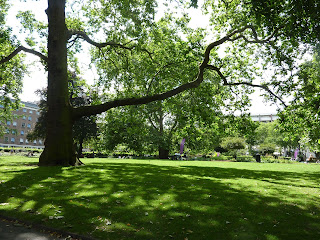
Brunswick Square in Bloomsbury
once part of Captain Coram's Foundling Hospital grounds.
The Foundling Hospital exhibition The Triumph of Pleasure: Vauxhall Gardens 1729-1786 was a fascinating exploration of the social and cultural importance of the popular South London amusement grounds during its prime years. The artist Hogarth encouraged the Garden's owner Jonathan Tyers to use up-and-coming artists for decorating the structures. The composer Handel was de facto music director writing pieces for the Garden's entertainments and promoting new music from other contemporary composers. Both Hogarth and Handel were important patrons of the Foundling Hospital.

We then decided to see if London was collapsing under the influx of Olympic visitors, and we found even ordinarily crowded spots like Kings Cross to be very quiet for a Saturday afternoon. A number of countries have set up National Hospitality Houses for their athletes and nationals in London, for commerce and trade delegations, and in some cases to welcome visitors.

Schnitzel and Dumplings, Austria at Trinity House

Denmark had a Lego Olympic Stadium . . .

. . . and a Lego Windmill at St Katharine's Dock
Our good weather held until Sunday when the rains did come, heavy squalls at time, a bit of hail in the morning too. So we went off to the Whitechapel Gallery in East London to see a small exhibit featuring the Government Art Collection. The Government owns 10,000 pieces of art collected over the past 100 years and used to decorate British government buildings everywhere in the world. The whole collection can be accessed on the link. Most of the pieces have been purchased or donated, but there are also Government Commissions including a new decorative façade for the Whitechapel Gallery by Rachel Whiteread commemorating London 2012.


The Gallery was built in 1901 to bring art to the residents of the impoverished East End. Plans for an Arts and Crafts style mosaic frieze to finish the façade never happened. The title is Tree of Life because there are tree motifs in the decoration of the side towers. There are certainly overtones of the Secession Building in Vienna.

Projects that enhance the East End have been a special part of the Cultural Olympiad because the upheaval of constructions has been borne by the East End residents. And there are influential cultural critics who feel the authenticity of the East End has been forever damaged by the incessant regeneration projects from the Isle of Dogs Canary Wharf to Stratford's Olympic Park. Last week's Persephone Post, a daily message of cultural uplift that starts my weekdays off right, was themed to the East End and included a link to the blog Spitalfields Life,  an effort to record the street life and quirky characters in Spitalfields, an area better known now for hipsters and Tracy Emin. The Post recommended an exhibition at Christ Church Spitalfields by a local photographer who has been taking photos of his neighbours and neighbourhood since the late 1940s when he was a boy. Since we were nearby in Whitechapel, we walked over to see the exhibit. Many of the photos on display, and more, can be seen on the Spitalfields Life link.

Monday, July 30, 2012

An Evening on the Thames

Friday, 27 July

I have watched the London 2012 Opening Ceremony twice on TV, and I think it is pretty much the most brilliant spectacle I have ever seen. I would like to see a DVD version at half speed which breaks down and explains every cultural reference in the programme. After 14 years in London, I probably got about half of what was on offer. The overwhelming impression is how many legends — not just celebrities — but legendary icons, float along through the stream of British culture. Danny Boyle just kept nailing them one after another as the show proceeded. What does it mean to be British has been a question much in public debate over the past decade as the Labour Prime Ministers, Blair and the Brown, who promised so much, brought such disappointment during their terms in office. Humour, self-deprecation, adaptability, and creativity quickly spring to mind. I found the Beijing opening ceremony to be a bit creepy with thousands of robotic performers mesmerizing the crowds. Danny Boyle's thousands of performers did just the opposite, fomenting an explosion of creative chaos with the audience of billions experiencing successive moments of joy, pathos, comedy, terror, and grief. Although I gather US audiences missed out on the grief segment by the substitution of an interview with an inarticulate swimmer for the stunning dance choreographed by Akram Khan accompanied by Emeli Sandé's lovely rendition of Abide With Me (which I read is an anthem sang at rugby competitions in the UK). This website has posted the segment that was cut by NBC.

We didn't see the Opening Ceremony until Saturday morning because we had booked a cruise on a tall ship to commemorate the Olympics. The Royal Greenwich Festival included a parade of tall ships that will remain docked in Woolwich through the Olympics. The original plan was to offer high priced dinner cruises aimed at businesses wishing to entertain clients. But guess what? Surprise, surprise, freebie offers like this breach recent bribery legislation so the ships were left with no takers. They cleverly came up with a new marketing plan to sell tickets for 2-hour cruises on the Thames. Since the Opening Ceremony was to have fireworks, some bright light came up with the idea of extending the cruise to wait for the fireworks. The ceremony ran nearly four hours so we wound up, freezing cold and on the water until nearly 1:30 in the morning!

When I saw the opening segment of the Opening Ceremony with its trip down the Thames from source to mouth, I was happy we had been on the river while it was first broadcast.
Boarding the tall ship Thalassa, a Dutch ship from Harlingen
Passing through the Thames Barrier that prevents London from flooding
during tidal surges, but not if the Greenland glaciers keep melting this quickly.
Canary Wharf
Our very newest Thames crossing transport: the Emirates
Airline Cable Car from the Millennium Dome . . . 
. . . to the Victorian Docks
The Old Royal Naval College in Greenwich,
last seen here on the blog as the Australia Stage at the River of Music
Security and the source of . . .
. . .  black helicopters scanning the skies
Another of the fleet of tall ships

Although we had to motor in the Thames, the crew raised
 some of the sails 

Tower Bridge with its Olympic lights. At one point we thought we would not make it to the  Bridge
because the Captain was told the river was closed to traffic. Later when we began moving,
we learned the river was closed so David Beckham could bring the speedboat
carrying the torch across the river to the Olympic Park

At long last the single set of fireworks we could see.
 The Olympic Park is not near the Thames.
Fortunately we made it onto the trains and Tubes that were running until 2:30 in the morning for this event. Everyone else on the train at that time was an Olympic volunteer coming from the Ceremony. After watching it on TV, Bob remembered one of the women was carrying a pail, which seemed odd to him at the time, but he realised she must have been one of the 1000 volunteer drummers!

Thursday, July 26, 2012

The Olympic Torch Relay: Day 69

Who says there is no Olympic spirit in the UK? Oh that would be the Mitt-ster busy making people dislike him at an exponentially rapid accelerating rate. Having lived in Massachusetts when he unsuccessfully ran for the Senate, having been a steady visitor to the State when he was governor, and watching his train wreck of a Presidential campaign, I can say with some confidence that anyone who meets Mitt, despises him ever afterwards. And he is proving true to form here in London.

According to The Guardian:  David Cameron wasted no time in rebuking Romney hours after his remarks were broadcast. On a visit to the Olympic Park, the prime minister said: "We are holding an Olympic Games in one of the busiest, most active, bustling cities anywhere in the world. Of course it's easier if you hold an Olympic Games in the middle of nowhere."


Quite clearly Mitt was not near Camden Town at 6:30 this morning when thousands of people turned out for the start of this penultimate day of the Olympic Torch Relay starting here in North London and ending the day at a rock concert in Hyde Park. The Torch Relay was planned to reach every corner of the United Kingdom (that includes Northern Ireland) over 70 days. Overnight, the Flame will be trucked to Hampton Court Palace where it will be loaded onto Gloriana, the boat that led the Queen's Jubilee Thames Parade, and rowed down to Tower Bridge in the City of London by Olympic rowers by early afternoon. Then it will be hidden in London's City Hall before it is taken (by secret route) to Stratford tomorrow night.


We had no idea so many people would turn out for this so early in the morning. 


The torch can just be seen in the centre of the photo

And there it is! Sir Clive Woodward, coach of the England Rugby Team
in 2003 when they won the World Cup.

A better view of the Torch, but not of the bearer.

An Olympic legacy photo! 

Tuesday, July 24, 2012

The Olympic Park Today

I do hate malls, and when Westfield built a new mall — the biggest in Europe, no less — at the Olympic Park, I never thought I would become a regular patron. That was before I discovered the easiest way to get to the large stores I use most often was the 20 minute train ride from the Overground station that is a 5 minute walk from home. So needing toothpaste made today a good day to see what the Olympic Park looks like a few days before opening.
This will be the Stratford Entrance into the Olympic Park.
The Olympic Stadium
Anish Kapoor's Arcelor Tower which can be climbed for a fee.

A River of Music

Saturday and Sunday, 21-22 July


Royal Victoria Dock with Canary Wharf
and Millennium Dome in the distance
The universe has realigned. Perhaps the gods and goddesses of Olympus have not lost their powers after all. Yes the errant polar jet stream has at last moved back to more northerly latitudes, where it should circulate at this time of the year, and our winter-summer of rain and gloomy darkness is over. At least for this week, we have the best of summer in London: blue skies, warm breeze, and no rain in the forecast.

The Olympics begins with the opening ceremony on Friday. I had lunch with a friend today who may have a ticket to one of the dress rehearsals. Her daughter was a classmate of Danny Boyle's daughter, and they have saved a seat for her daughter. But the problem is her daughter is in the States, and all the flights to London are fully booked. So my friend will use the ticket herself. This is the third story I've heard of people trying to get to London this week, but there are no seats available. I guess it's true that the whole world will be in London by the end of the week.

This weekend a good part of world music was in London playing at the  River of Music Festival sponsored by BT — British Telecom — for the Cultural Olympiad. A particularly good idea to bridge the connection between culture and sport, the event was to have musicians from every country sending athletes to the Olympics playing for London. Even better, they were nearly free concerts, costing only the £3 Ticketmaster fee on each ticket. Five stages along the Thames featured music from Asia, Africa, America, Europe and Oceania. There was also an extra Europe stage in Trafalgar Square, a non-river site.

Early on Saturday we set off for East London, the former port, docks, and industrial sector of the city, that is slowly being rebuilt, rehabbed, revived or gentrified, depending on your point of view. The initial Docklands projects in the 1980s resulted in the Canary Wharf financial centre which is now a thriving node of London. The Olympic Park development is designed to create the same magic in the Stratford area of northeast London. Despite being one of the world's oldest cities, London covers such a large land area, it has been able to use a growth strategy associated with the new cities of the western and southern United States where available land encouraged sprawling development that increased the area and population of cities like San Diego, Houston, Phoenix and Atlanta. London is encouraging dense nodes of development on brown-field sites using transport systems. New light rail lines cut through derelict industrial sites and old rail lines are connected into an Overground system that links with the Underground.

The Africa Stage was located in one of these derelict sites that is now being turned into something called the London Pleasure Garden.  Pleasure Gardens were popular places of entertainment in the 18th century. They were the amusement parks of Georgian London with gardens to promenade through, music and theatre productions, and one of the only places where different classes might intermingle in a seriously class-bound culture. This Pleasure Garden is being put together with a street edge by community artists — with funds from otherwise evil financial institutions.

The Docklands Light Rail station Pontoon Dock is right across the road from the ornate pink entrance to the grounds. Right away you enter a fantastic plaza and promenade along the old dock.

Follies, popular in Georgian England, abound, here with an urban edge: emulating the pyramidal roof of Canary Wharf's first office tower and the space ship form of the Millennium Dome. Both buildings are visible from the Garden.
Surrounding derelict buildings add extra character to the site. The Millennium Mill is a famous landmark.
Silo D was new to us.

This area of the Royal Victoria Dock was the centre of flour milling for grain arriving from around the world. The grain was off-loaded from ships into Silos such as D, and then milled for markets around the country.

The African musicians we heard were fantastic.

Seckou Keita, from Senegal
and the Batamba Syndicate, from all over West Africa

Seckou Keita playing his amazing stringed kora
SAfricanto from South Africa . . .
. . . with Hugh Masekela


A beautiful day with sun and blue sky as the day went on. Sadly we had to leave mid-afternoon — although our old bones had enough of sitting on the pebbled ground — to go off to the Barbican to see the premier of Alfred Hitchcock's first film The Lodger: A Story of the London Fog from 1927 which has just been restored by the British Film Institute — celebrating Hitchcock for the Cultural Olympics — with a new score commissioned from Nitin Sawhney who was conducting the London Symphony Orchestra. Quite fantastic. Susan and I saw The Lodger ten or more years ago when it had been previously recently restored, but the head of the BFI explained before the screening that the technology to clean the film did not exist ten years ago, and I do remember it was very spotty and a lot more foggy too. An added surprise was to discover that our favourite graphic artist E. McKnight Kauffer did the titles for the film.


Sunday we headed to Greenwich on a gloriously sunny day. The Oceania Stage was set in the Grand Square of Christopher Wren's magisterial Royal Naval Hospital originally built for pensioners of the Royal Navy to match the digs Wren designed for old soldiers in Chelsea.

I wonder what Wren and Hawksmoor and Van Brugh
and all the other leading lights of Georgian design would think of this.

George II, the really obscure George among the four Georgian Georges,
seems ready to assist the cameraman.
We listened to the Australian Crooked Fiddle Band and The Black Arm Band Company, an aboriginal soul band who sang songs about their history.
The didgeridoo player and his music were especially wonderful.

Then we headed off to the Tower of London where the Americas Stage was set in the moat outside the Tower Walls. What a great venue for a concert.
The trebuchet adds an extra level of antique security.
Or perhaps it's defending the Tower from the advance of The Shard
London's newest "iconic" landmark.
Across the river, London's bulbous City Hall with a glass
Olympic Torch installation from EDF with animated figures and flames.
Saturday's line-up had been musicians from the States; Sunday was  devoted to the other Americas. We heard Ondatropica from Colombia, the Creole Choir of Cuba, and La Bottine Souriante from Quebec.

We were pretty exhausted by the time arrived back home Sunday evening, but for once it was still sunny and bright as London summer evenings should always be. And we definitely felt culturally enlightened with music from four continents — two Americas, Africa, and Australia — in our heads. Two thumbs up for the Cultural Olympiad.