Sunday, September 15, 2013

4. The Greater Germany continued in Metz

In between our concert weekends, we looked for nearby places to visit, and Metz, the leading city of Lorraine in Carolingian times popped up on Bob's music radar when he chanced on a mention that Gregorian chant was invented in Metz . . . which by the way, and emphasized in every guidebook, is pronounced "Mess" in French. My German pronunciation is adequate thanks to four years with Fräulein Phillip in high school. My French pronunciation is dismal, but I am totally lost when every place name seems to be spelled in German, but pronounced in French.

So how could we not leave Alsace for two days to see the birthplace of Gregorian chant.
When Alsace was passed to Germany in the 1870s parts of Lorraine went with it, including the city of Metz. The location of Metz would have made the city the border gateway to the New Germany, so a monumental railway station was constructed during the first decade of the 20th century . . .

. . . heavily decorated with Teutonic symbolism. And built at the same time, Haut-Koenigsburg was being reconstructed.

The city is lovely, lying on the Moselle River where this folly, the Temple Neuf, was built in 1904 undoubtedly to emulate the site of Notre Dame in Paris. Greater Germany would have to wait a few decades to capture the real thing, if only for a brief time.

The beautifully landscaped promenade along the Moselle was a lovely walk on a hot summer day. 

Metz's most famous attraction is the Cathedral of St Etienne, begun in the early 13th century, within the walls of a 10th-11th century basilica style church. Construction continued for 300 years. 

The cathedral is noted for the towering height of its nave, the third highest in France . .  .

. . . and its curtain walls that are nearly all glass. I was too overwhelmed by the richness of the glass on such a sunny day to take a decent photograph, so Bob took this one of the 14th century Rose Window by Hermann von Münster.  

Those flying buttresses of Gothic engineering created a new sort of spiritual space very different from the  small windows and fortress like walls of the Romanesque churches of the previous century. Metz has the most window surface of any medieval cathedral.

The windows span the centuries with the original 14th and 16th century glass, but includes modern windows too.  These are two of the three windows designed by Chagall in the 1950s and 1960s . . .

. . . depicting Old Testament stories.

The Cathedral's crypt was a bit of a disappointment since the earlier Romanesque features had been buried under the Gothic rebuilding. But it did have this wonderful sculpture of the Graoully, the local dragon terrorizing the people of Metz in the 1st century. The legend is that St Peter sent Clement to convert the people of Metz, who agreed if he would take care of their dragon problem. Clement was a successful slayer, Metz became a Christian city, and Clement became the Bishop of Metz and a saint too.

Walking to the museum, we passed under a modern day Graoully which still serves as Metz's mascot.
The Musée de la Cour d'Or is a fantastic museum that chronicles the history of Metz beginning with the archaeological remains of a Roman bath beneath the building. This exquisite ivory carved casket depicts Charlemagne's son Louis the Pious being crowned Holy Roman Emperor by Pope Stephen IV in 813.

Metz also has one of the oldest Christian churches in Europe.  St-Pierre-aux-Nonnains was built by the Romans in the late 4th century, probably as a gymnasium. Fifty years later, Attila and the Huns attacked and burned the town . . .

. . . but the walls with their distinctive Roman brick course between stone and mortar courses were left standing, and used to build a convent chapel in 615. The chapel was enlarged and modified with an early chancel by Bishop Chrodegang of Metz . . .  

. . . with a Romanesque nave . . .

. . . and with Gothic vaulting over the next 900 years.  

Nearby stands another unique building, a Templar's Chapel dated to the early 13th century. The Templars, the Pope's Army always ready for another Crusade in the Holy Land was established in 1133 in Metz, and became a command centre for troops leaving for the Second Crusade in 1145. The chapel was probably built around 1200 . . .

. . . the Templars were dissolved in 1312, and the chapel was passed to other  religious orders  who would have been responsible for the frescoes that decorate the interior. Metz was a Free City of the Holy Roman Empire until 1552 when Henri II annexed the city to his expanding kingdom of France. When Henri fortified the city, St-Pierre-aux-Nonnains became an arsenal and the Templars Chapel became a gunpowder store. The restoration of the two buildings were part of the early 20th century plan to emphasize the German history of the region.

And what about Gregorian Chant, the foundation of Western music? It has been known for a long time that Gregory the Great, Pope from 540 to 604, had nothing to do with Gregorian Chant although it was named after him as an honorific. Recent scholarship has indicated that Chrodegang, Bishop of Metz from c.740 to 766, had a great deal to do with establishing Gregorian Chant. Until the 8th century there was no core liturgical rite, but rather regional rites were in use across Christian practice. When Pope Stephen II travelled to Merovingian Gaul in the 750s, he said mass using his preferred Roman Rite chant. King Pepin liked  it so much, he abolished the local Gallic chant, a move not popular in Gaul. When Charlemagne became king, he asked Bishop Chrodegang of Metz to promote the new Roman Rite. What Chrodegang did was join the Roman and Gallic Rites into a new system that included eight modes and neumes to indicate melody. The new Rite was originally named Messin, to honor  Chrodegang of Metz.
In 748, Bishop Chrodegang founded an Abbey in Gorze a few miles outside of Metz. The 13th century parish church is all that remains of the Abbey where Chrodegang introduced his Messin Chant.

The Last Judgement
Perhaps he is not a fan of the new chanting?


Sunday, September 8, 2013

3. Alsace of Greater Germany


The view from our hotel window is not a volcano about to erupt, but a peak in the Vosges Mountains where the Castle Haut-Koenigsburg sits at the very top.  

The geomorphology of Alsace is simple, and can nearly be seen in this hazy photograph.  The eastern boundary is the Rhine with its very wide, very flat, very arable floodplain. The Vosges Mountains rise to the west of the floodplain. On the lower elevation hills bordering the floodplain, the vineyards  of the local wine industry spread up the hillsides. The high peaks rise steeply and vertically, dotted with the remains of medieval castles strategically placed to defend themselves against invasion.

Haut-Koenigsburg was built sometime in the middle of the 12th century, burned by its neighbours in 1462, and rebuilt in a "modern" defense style in 1479. During the 30 Years War, Sweden's Protestant  forces lay siege to the castle, held by the Catholic Hapsburgs, for 52 days in 1633. When Sweden prevailed, the castle was pillaged and burned and left as a ruin for 250 years.

Another of those highly forgettable wars, in this case the Franco-Prussian War of 1870-71, handily and unexpectedly won by the Prussians, resulted in a peace treaty that transferred Alsace and a bit of Lorraine to Prussia. At that time Germany, under the leadership of their strongest state Prussia, was busy drawing together all its small independent states and duchies and electorates into the unified nation of Germany. Having a castle that dated back to the earliest days of its powerful Holy Roman Empire history was a gift too good to not use as a symbol of the powerful new German state in the planning. In 1900, the Kaiser assigned restoration architect Bodo Ebhardt to rebuild the castle as historically accurate as he could through archaeological evidence, source evidence, and a bit of imagination.

If you have seen the Jean Renoir film you have already seen the results of Bodo's eight years of painstaking work because it was used as the location of the impregnable mountain fortress where the prisoners of war were held.

The scale of the work done on the castle is monumental . . .

. . . using archaeological finds. . .

. . . a bit of faux medieval imagination . . .

. . . and lots of whimsical detail.

This charming angel on a stairwell railing leads to my favorite room. . .
Can you think of a better setting to enjoy a Teutonic daydream listening to a bit of Wagner?
Surrounded by beautiful knights . . .
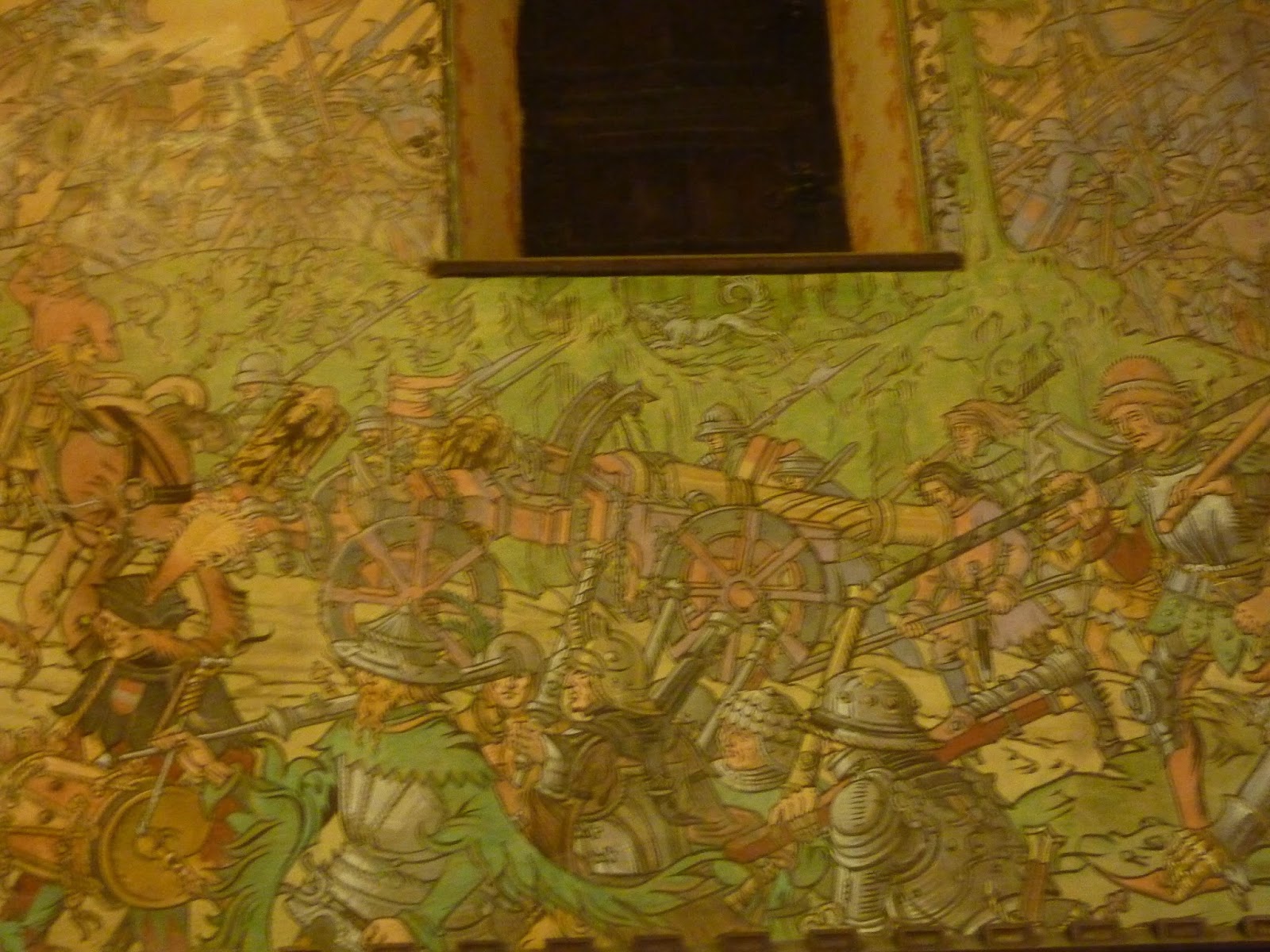
. . . marching battalions . . .
. . . under the Imperial Eagle. After reading about the history of the castle, I thought, how appropriate to use it as a setting for an anti-war film in 1937 when everyone in Europe knew a second war was imminent.

After spending much longer than anticipated at the castle, we found a restaurant willing to feed us a light lunch even though it was past two o'clock. Then we headed to our third concert in the series. De Caelis, five women from Normandy, with a mixed programme of medieval songs and modern commissions influenced by early music. 


Friday, September 6, 2013

2. History happens in Alsace

Field of wild flowers or a Monet painting?
One of the issues to be faced when travelling in France, especially in rural France, is that the people of France hold on to the belief the pace of life should match the needs of people, not the other way round. When you are on holiday, you also want to slow down the pace of activity, sleep a bit later, linger over breakfast. But in France you then bump up against the midday closure of nearly everything a tourist wants to see and do. The universal shut down of shops and museums and post offices to mail post cards and pretty much everything else from noon to 2:00 p.m. puts a big dent in the itinerary for the day. Of course the restaurants remain open so you can relax over a two to three hour lunch with a bottle of wine like everyone else, and then try to remember what it was you had planned to do in the morning that seemed important before the bottle of wine.


When you wake up to this view . . . in a charming hotel . . .

. . . with a patio garden overlooking the River Ill . . . it is even more difficult to get moving . . . but we are so glad that we did make it into the centre of Sélestat with nearly 90 minutes to visit the Humanist Library before it closed for the lunch break.

 
In corners of my brain little wisps of information learned long ago in World History class live on. Back then, we learned after the Romans were bested by the barbarian teams not much happened until                                                                      the Merovingians came along, and I loved them because they had great names like Clovis and Pepin and Dagobert, but the greatest of them was Charlemagne, and he was great because he revived learning in Western Europe. Through that doorway with the ornamental grille is the exhibition room of the Humanist Library in Sélestat, the most amazing museum you may have never heard of (I hadn't), where that idea comes to life. 

The Library prohibits photography in the display room, but this website offers some photos of their treasures. A book from the 7th century. A 10th century copy of Vitruvius's ten books on architecture from the 1st century that was owned by the Bishop of Worms. A 10th century manuscript of Horaces's Odes and Ars Poetica packed with comments in the margins written in the tiniest of script. My personal favorite is the book they call the "Birth Certificate of America,"  Matthias Ringmann's 1507 Cosmographiae which indicates worries about gender inequity have a long history: "Keeping in mind that Europe and Asia have been christened after female names I can not conceive why the [new lands] should not be named after Amerigo Vespucci, the Country of America, after its discoverer. . ."

The remainder of the exhibition documents the spread of book publishing with the introduction of movable type, another of those wispy ideas left over from World History. Sélestat was an early centre of printing because of its influential Humanist School, the source of the Library, which trained an early generation of Humanist scholars. 


We popped into Sélestat's Romanesque church, dedicated to Sainte Foy,
 built circa 1170 to 1180 . . . 

with its beautiful carvings . . .

. . . and doorway protectors

And into the nearby Gothic church dedicated to St George, begun in 1220,
with its fantastic stained glass windows.


We then headed off to our evening concert on the road that runs along the Rhine River, and a roadside sign reminded us that Alsace has history much more recent than the Middle Ages. The Maginot Line was the carefully planned, but ultimately useless, border defense devised by War Minister André Maginot to protect France from another invasion . . .

. . . by neighbouring Germany who was not very far away. The Maginot Line was useless because the Germans attacked through Belgium, and blitzkrieged their way through the Belgium-France border, and were in Paris is no time at all. When the attack came to Casemate 253 in June 1940, the 30 soldiers could not hold the bunker for long against a force of 200 German soldiers.

According to the guidebook, the Maginot Line emplacements were offered to soldiers and communities, and some have been turned into museums and memorials like this one. They also had this Sherman Tank with its wartime route from the Western Desert of Libya all the way to Berchtesgaden proudly displayed. . .

. . . and this piece of a Bailey Bridge, the portable bridges used by UK and US troops to cross rivers where the bridges had been blown up for strategic reasons . . . such as on the Rhine . . . but were needed as the Allies headed toward Berlin.
Our Romanesque church for tonight's concert pushed us back into history with this octagonal church built circa 1050 with the same plan as Charlemagne's chapel in Aachen built 250 years earlier. The Ottmarsheim church was built by a Habsburg Count for the Benedictine convent he founded, and where he intended to be buried.
 The French group Obsidienne entertained us with both serious music and humorous pieces. I guess it would have been better if we understood enough French to understand the recitations from a satiric manuscript of the 15th century.
The walls of the galleries decorated with frescoes and paintings
was a beautiful setting for  the concert.


Thursday, September 5, 2013

1. We arrive in Alsace


Friday, 29 August 
Everybody probably knows that Bob loves Early Music. He loves to sing it. He loves to listen to it both live and recorded. And he loves to pick out Early Music Festivals to attend. And there are so many of them.  So when our autumn trip to the States was pushed off because of commitments here, and he read about the Festival Voix et Route Romane, 10 concerts, over 3 weekends, in Romanesque churches in the Alsace region of France, we were booked and ticketed and ready to go.

Lunch!
Alsace is the region of eastern France best known for being passed back and forth between France and Germany from the Prussian War of 1870 when victorious Germany won the region, only to lose it in the Treaty of Versailles at the end of the First World War, and to regain it with the Occupation of France in 1940, and finally the permanent reversion to France in 1945. The European Parliament sits in the Alsatian city of Strasbourg as a symbol of the unification of purpose brought about by the European Union.
We flew into Basel, an airport that straddles the borders of Switzerland, Germany, and France. In fact  passport control offers separate lines for entering each country, and airport exits are marked for your country of choice. We picked up our rental car and headed out the French exit.

The Route Romane or Romanesque Road is a tourist marketing tool devised some 20 years ago to raise the tourism interest in Alsace beyond the popular Wine Route. Twenty-two Romanesque churches of the 12th century have been linked in the route. Some are much older, but were modernized in the new style. Most have been modernized in the following centuries with Gothic, Baroque, and later additions. Some were wiped out in wars and have been completely rebuilt.

From the airport we headed into the Sundgau, the southern region of Alsace that lies in the Jura  mountains, the foothills of the Alps. Something I did not know is that the Jura is the root of the geologic term Jurassic . . . a great lunch in the charming town of Ferrette, but no dinosaurs. Up on the hillside is the ruin of the castle belonging to the Counts of Ferrette. Through marriages, treaties, family connections, the title of Count of Ferrette belongs to the Prince of Monaco.

The first of the Romanesque churches on our route was Saint-Jacques-le-Majeur in Feldbach, built around 1145 by the Count of Ferrette when he established a Benedictine Convent here.  A very plain exterior of Jura limestone . . .

. . . but an interesting interior arrangement. Entering the front door in the west end, there are three bays of rounded Romanesque arches . . .

. . . each with lovely carved capitals. This end of the church was the parish church for the residents of Feldbach.

. . . looking toward the east end, past the arches, the walls are solid stone, and this is where the nuns of the convent would have worshipped in the enclosed space. A wall across the nave, now removed, would have held the parishoners altar. The tiny porthole windows are the only source of natural light.
The theme of this year's festival is D'un jardin l'autre, so it was fitting the first concert was in the church of a former monastery at Eschau on the outskirts of Strasbourg with a historic garden.


A Great Pumpkin gets special treatment.

The crowd is queuing for our first concert at Eschau's church, built in the 11th century after an earlier church was destroyed "during the Hungarian invasions of 926," according to our helpful guide to the Festival churches. The church needed rebuilding after it was damaged in 1944-1945, and the reconstruction stripped it back to its Romanesque beginnings.

The problem with concerts in churches is that you can't see very much of the church. The apse with dramatic lighting effects await our first concert by an Estonian group, Heinavanker, who "sang Estonian chants and variations on them that were quite interesting." So says my resident music critic. And it was a terrific concert.