Friday, September 6, 2013

2. History happens in Alsace

Field of wild flowers or a Monet painting?
One of the issues to be faced when travelling in France, especially in rural France, is that the people of France hold on to the belief the pace of life should match the needs of people, not the other way round. When you are on holiday, you also want to slow down the pace of activity, sleep a bit later, linger over breakfast. But in France you then bump up against the midday closure of nearly everything a tourist wants to see and do. The universal shut down of shops and museums and post offices to mail post cards and pretty much everything else from noon to 2:00 p.m. puts a big dent in the itinerary for the day. Of course the restaurants remain open so you can relax over a two to three hour lunch with a bottle of wine like everyone else, and then try to remember what it was you had planned to do in the morning that seemed important before the bottle of wine.


When you wake up to this view . . . in a charming hotel . . .

. . . with a patio garden overlooking the River Ill . . . it is even more difficult to get moving . . . but we are so glad that we did make it into the centre of Sélestat with nearly 90 minutes to visit the Humanist Library before it closed for the lunch break.

 
In corners of my brain little wisps of information learned long ago in World History class live on. Back then, we learned after the Romans were bested by the barbarian teams not much happened until                                                                      the Merovingians came along, and I loved them because they had great names like Clovis and Pepin and Dagobert, but the greatest of them was Charlemagne, and he was great because he revived learning in Western Europe. Through that doorway with the ornamental grille is the exhibition room of the Humanist Library in Sélestat, the most amazing museum you may have never heard of (I hadn't), where that idea comes to life. 

The Library prohibits photography in the display room, but this website offers some photos of their treasures. A book from the 7th century. A 10th century copy of Vitruvius's ten books on architecture from the 1st century that was owned by the Bishop of Worms. A 10th century manuscript of Horaces's Odes and Ars Poetica packed with comments in the margins written in the tiniest of script. My personal favorite is the book they call the "Birth Certificate of America,"  Matthias Ringmann's 1507 Cosmographiae which indicates worries about gender inequity have a long history: "Keeping in mind that Europe and Asia have been christened after female names I can not conceive why the [new lands] should not be named after Amerigo Vespucci, the Country of America, after its discoverer. . ."

The remainder of the exhibition documents the spread of book publishing with the introduction of movable type, another of those wispy ideas left over from World History. Sélestat was an early centre of printing because of its influential Humanist School, the source of the Library, which trained an early generation of Humanist scholars. 


We popped into Sélestat's Romanesque church, dedicated to Sainte Foy,
 built circa 1170 to 1180 . . . 

with its beautiful carvings . . .

. . . and doorway protectors

And into the nearby Gothic church dedicated to St George, begun in 1220,
with its fantastic stained glass windows.


We then headed off to our evening concert on the road that runs along the Rhine River, and a roadside sign reminded us that Alsace has history much more recent than the Middle Ages. The Maginot Line was the carefully planned, but ultimately useless, border defense devised by War Minister André Maginot to protect France from another invasion . . .

. . . by neighbouring Germany who was not very far away. The Maginot Line was useless because the Germans attacked through Belgium, and blitzkrieged their way through the Belgium-France border, and were in Paris is no time at all. When the attack came to Casemate 253 in June 1940, the 30 soldiers could not hold the bunker for long against a force of 200 German soldiers.

According to the guidebook, the Maginot Line emplacements were offered to soldiers and communities, and some have been turned into museums and memorials like this one. They also had this Sherman Tank with its wartime route from the Western Desert of Libya all the way to Berchtesgaden proudly displayed. . .

. . . and this piece of a Bailey Bridge, the portable bridges used by UK and US troops to cross rivers where the bridges had been blown up for strategic reasons . . . such as on the Rhine . . . but were needed as the Allies headed toward Berlin.
Our Romanesque church for tonight's concert pushed us back into history with this octagonal church built circa 1050 with the same plan as Charlemagne's chapel in Aachen built 250 years earlier. The Ottmarsheim church was built by a Habsburg Count for the Benedictine convent he founded, and where he intended to be buried.
 The French group Obsidienne entertained us with both serious music and humorous pieces. I guess it would have been better if we understood enough French to understand the recitations from a satiric manuscript of the 15th century.
The walls of the galleries decorated with frescoes and paintings
was a beautiful setting for  the concert.


Thursday, September 5, 2013

1. We arrive in Alsace


Friday, 29 August 
Everybody probably knows that Bob loves Early Music. He loves to sing it. He loves to listen to it both live and recorded. And he loves to pick out Early Music Festivals to attend. And there are so many of them.  So when our autumn trip to the States was pushed off because of commitments here, and he read about the Festival Voix et Route Romane, 10 concerts, over 3 weekends, in Romanesque churches in the Alsace region of France, we were booked and ticketed and ready to go.

Lunch!
Alsace is the region of eastern France best known for being passed back and forth between France and Germany from the Prussian War of 1870 when victorious Germany won the region, only to lose it in the Treaty of Versailles at the end of the First World War, and to regain it with the Occupation of France in 1940, and finally the permanent reversion to France in 1945. The European Parliament sits in the Alsatian city of Strasbourg as a symbol of the unification of purpose brought about by the European Union.
We flew into Basel, an airport that straddles the borders of Switzerland, Germany, and France. In fact  passport control offers separate lines for entering each country, and airport exits are marked for your country of choice. We picked up our rental car and headed out the French exit.

The Route Romane or Romanesque Road is a tourist marketing tool devised some 20 years ago to raise the tourism interest in Alsace beyond the popular Wine Route. Twenty-two Romanesque churches of the 12th century have been linked in the route. Some are much older, but were modernized in the new style. Most have been modernized in the following centuries with Gothic, Baroque, and later additions. Some were wiped out in wars and have been completely rebuilt.

From the airport we headed into the Sundgau, the southern region of Alsace that lies in the Jura  mountains, the foothills of the Alps. Something I did not know is that the Jura is the root of the geologic term Jurassic . . . a great lunch in the charming town of Ferrette, but no dinosaurs. Up on the hillside is the ruin of the castle belonging to the Counts of Ferrette. Through marriages, treaties, family connections, the title of Count of Ferrette belongs to the Prince of Monaco.

The first of the Romanesque churches on our route was Saint-Jacques-le-Majeur in Feldbach, built around 1145 by the Count of Ferrette when he established a Benedictine Convent here.  A very plain exterior of Jura limestone . . .

. . . but an interesting interior arrangement. Entering the front door in the west end, there are three bays of rounded Romanesque arches . . .

. . . each with lovely carved capitals. This end of the church was the parish church for the residents of Feldbach.

. . . looking toward the east end, past the arches, the walls are solid stone, and this is where the nuns of the convent would have worshipped in the enclosed space. A wall across the nave, now removed, would have held the parishoners altar. The tiny porthole windows are the only source of natural light.
The theme of this year's festival is D'un jardin l'autre, so it was fitting the first concert was in the church of a former monastery at Eschau on the outskirts of Strasbourg with a historic garden.


A Great Pumpkin gets special treatment.

The crowd is queuing for our first concert at Eschau's church, built in the 11th century after an earlier church was destroyed "during the Hungarian invasions of 926," according to our helpful guide to the Festival churches. The church needed rebuilding after it was damaged in 1944-1945, and the reconstruction stripped it back to its Romanesque beginnings.

The problem with concerts in churches is that you can't see very much of the church. The apse with dramatic lighting effects await our first concert by an Estonian group, Heinavanker, who "sang Estonian chants and variations on them that were quite interesting." So says my resident music critic. And it was a terrific concert.


Saturday, June 22, 2013

Welcoming Summer the Egyptian Way

Once again we didn't make it to Stonehenge yesterday for the Solstice, but my favourite Londonist website Things to Do in London Today which sends a message into my inbox at 7 a.m., Monday through Saturday — Sunday is covered in Saturday's Weekend edition — offered an invitation to the Eye of Ra: A Midsummer Rite sponsored by University College of London's Petrie Museum of Egyptian Archaeology. Despite good intentions of visiting for many years, I had never been to the Petrie.

Meanwhile, whilst doing some morning errands, Bob came home all enthused that the new design London bus was being launched on the 24 Route in South End Green this morning. And since the 24 bus takes us to UCL and the Petrie Museum, what could be a better day out in London.

The shiny new London bus, designed by Thomas Heatherwick. There are staircases front and back, plus an open platform at the rear that can be used to hop on and off the bus in stopped traffic like the beloved, but retired, Routemaster buses allowed passengers to do, but only when a conductor is on duty on the platform. That's the intended plan anyway. 

Here is the Eye of Ra on the roof terrace of a UCL building . . .

. . . where we could post our requests to Ra for his intervention

We arrived early before the music and entertainment programme, but not before the excellent free food and drink.  A healthy mixed grain and vegetable and nuts and seeds porridge. And Black Cocktails that were an interesting mix of vodka, almond milk, with a spritz of chili and licorice flavouring. Thank you Ra. He replied with some gusts of wind and a very brief torrent of rain.


Jeremy Bentham opted to remain in his purpose built closet for the celebration.

Then on to the Petrie Museum itself, which in any other  place would have been a world class museum instead of crammed into a few small rooms in the University's science library. Flinders Petrie was a professor of Egyptian Archaeology and Philology at UCL from 1892 to 1933. Petrie's lengthy Wikipedia entry includes reference to his controversial beliefs, disagreements with other Egyptologists, and the tale of his missing head. 


 These Coptic Socks date from c. 400 AD. Last year the museum had a workshop to knit the socks,
and this link gives you the instructions and some history. 


The museum is currently hosting an art installation mounted by their Artist in Residence Cathy Hayes, who prefers the title Timekeeper in Residence to match the subject of her work entitled A Report on Progress which catalogues the variety of ways Time and Progress have been modeled, shaped, symbolised, illustrated in different eras by scientists, philosophers, theologians, historians, and artists. This photo includes planetary models, timelines, arrows, and lots of red string linking artefacts. Fortunately there is a Timekeeper website that links to explanations through the project including a link to the artist's A Storm is Brewing blog. I am going to study all of this before a return visit.

These figures are modeled on illustrations on a medieval timeline.

When all is said and done, this bird has remembered
to bring an essential umbrella for  his eternal life in London.  


Monday, April 8, 2013

Ten Days in Istanbul

Our last day in Istanbul. We're tired, and the weather is lovely,  so we decide to spend the day riding ferries. I had thought we could find ferries to take us from ferry landing to ferry landing up the Bosphorus to stop and see sights along the coast, but alas, we could not find these ferries, so eventually we opted for the short one-hour cruise.
The fortress at Rumeli Hisari was built on the European side of the Bosphorus by Mehmet II, the Conqueror,  to match  an older fortress on the opposite Asian side, allowing him to control all traffic on the water as he laid siege to the city of Constantinople.  800 years of failed attempts required some new clever strategies to succeed. He bypassed the chain used to close the Golden Horn, by having his army carry 80 galleys overland from the Bosphorus on a mile long plank road he built.  The ships could then be launched directly into the Golden Horn. The siege lasted less than two months.
Looking up the Bosphorus to the Black Sea whose borders include Turkey, Bulgaria, Georgia, Romania, Ukraine,
 and Russia. The Bosphorus is only 20 miles long, but its strategic importance is incalculable.
It is Russia's only outlet to the Mediterranean Sea.
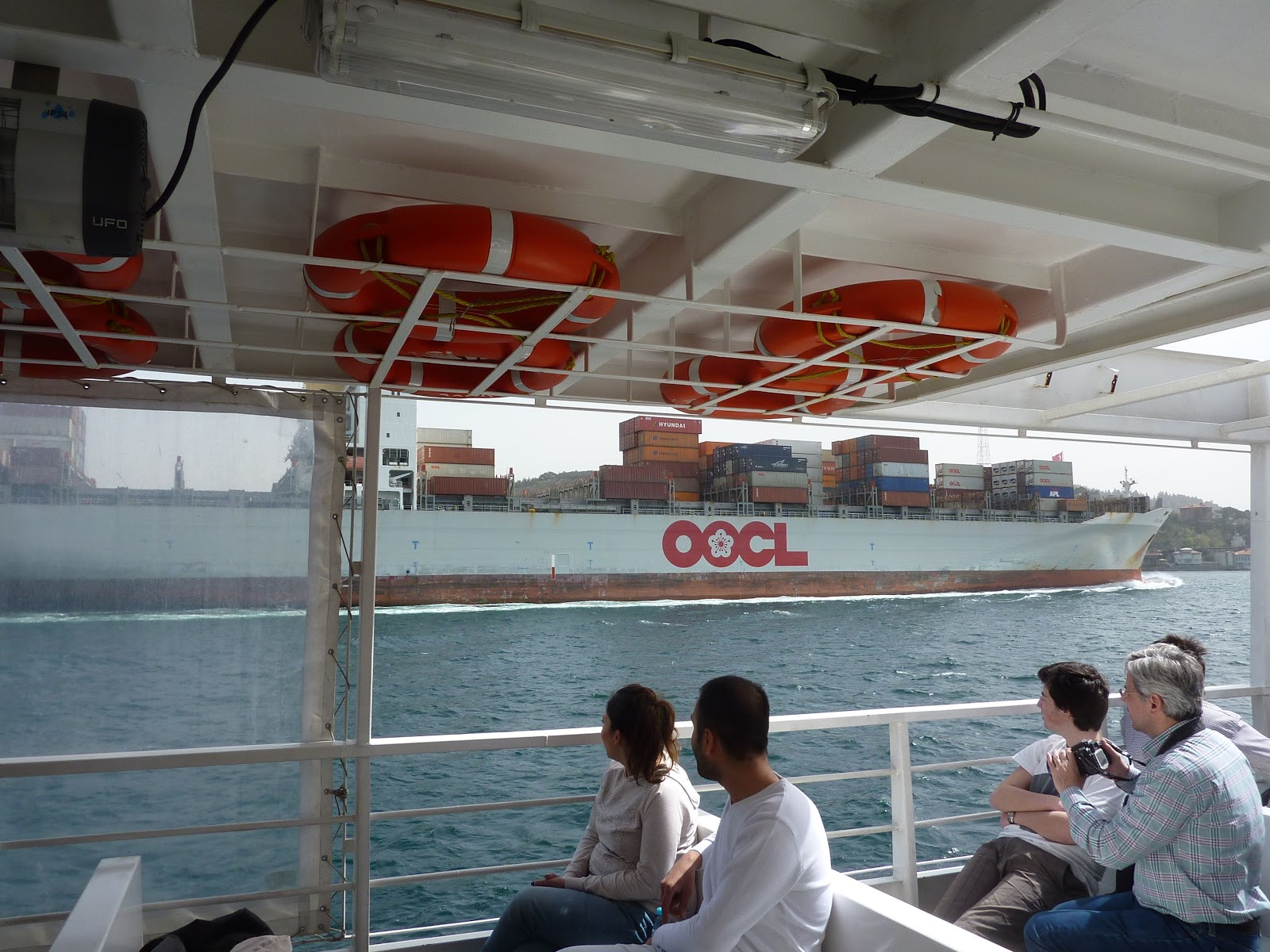
It is one of the world's busiest shipping lanes with tankers and container ships
— this one said Chicago on the front — carrying grain from Europe's breadbasket and oil from Russia .
After supper at the favorite fish restaurant we had eaten at earlier in the week,
we took a last look at the exterior of the magisterial Haghia Sophia.

Saturday, April 6, 2013

Nine days and nearly done

Our holiday is winding down and the weather is perfect so wandering to see the things left undone was the plan for the day. Bob saw a notice about this exhibit in Time Out Istanbul monthly magazine when we arrived, so we headed to the other side of the Golden Horn.
The exhibition was not very exciting because there were no original maps on display, just photographs of  very old maps that will be available as a coffee table book on historic maps. The university art center building hosting the exhibit was much more interesting. The Cannon House was the Ottoman Empire's military foundry established by the Conqueror himself, although this building dates from the early 19th century.
The exhibit's focus was cartography prior to 1513 when the Piri Reis map was  drawn using sources that have long been lost, including Columbus's original maps of the Caribbean. Only the western third of the map is extant, but that includes the east coast of Brazil making the map one of the earliest maps to include depictions of the New World.  Piri Reis was an Ottoman admiral and cartographer, and the map is in the Topkapi Palace Library collection. ( I forgot to take a photo of the photo map, so this image is borrowed from Google images.)
Then we moved on to a truly unique museum, Turkish Nobel Literature Prize winner Orhan Pamuk's Museum of Innocence. As a young writer, he conceived the idea of writing a novel told through the material objects that define a person's life in the place where the life is led. He began collecting everyday objects with a vague idea in mind for the novel, which as he writes in the book about the museum (above right) became an obsession during the late 1990s. When he began seriously planning the project he realized he had to have a place to set the novel before he could begin writing if the idea was to work.
He bought and renovated this house, which is now the Museum of Innocence, as he wrote the novel with the same name.  Open to the public for rather an enormous fee (25 Turkish Lira, the same price as a ticket to Haghia Sophia or to Topkapi Palace) unless you are carrying the book with you. Then you are admitted free. Bob's copy (above left) bought for 25 Turkish Lira – you can do the math, but at least we now have the book to read, not just a ticket stub — gave him free admission and a special stamp on page 520. (I also borrowed this photo from Google images.)
The museum has a special vitrine display for each of the book's 83 chapters.  Above are Chapters 2 through 5. Not having yet read the book, traveling through the 83 chapters was fascinating. Through the artifacts, I have an idea of the events that transpired, but no grasp of the story line. No photos were permitted, so this too is from Google images.

We ended the day by walking across the Galata Bridge over the Golden Horn.
The lower level is for eating fish.
The upper level is for catching fish a for walking.
The Old City ahead . . .
The Bosphorus to the left . . .
The Ataturk Bridge to the right . . .

Thursday, April 4, 2013

Eight Days On


I can understand why people are so intrigued by Istanbul. The history is so deep, with so many layers, and somehow they all still have a presence in the city today. Moving through the city is moving through a time machine of cultural history. Today was not an entirely successful day in that we were looking forward to visiting the Naval Museum, only to discover on arriving that the museum will be closed until summer to complete the building works of a huge new wing. At the ferry terminal next to the museum was this huge monument to Barbarossa, the pirate, the slave trader, the diplomat, and the admiral of the Ottoman fleet during the 16th century. 
Nearby the closed Naval Museum was the closed Dolmabaçe Palace. The palace is regularly closed on Thursday, so we were not surprised or disappointed, but in the time travel history, this is the palace built by the modernizing sultans of the 19th century to pull the mouldering Ottoman Empire into the world of European glamour. They gave up the medieval Topkapi in favour of a place where the royalty of Europe could drop by for a visit. Of course they didn't give up the bizarre world of the Harem when building a modern palace. Jason Goodwin's 4-volume (so far) mystery series about Yashim the Eunuch set in  the 1830s is a wonderful resource for painlessly learning about the lives of the Ottoman rulers.
The next step in modernising was to create a shopping street promenade like  other European capitals. The  Grande Rue de Péra was lined with shops and cafés and embassies and churches (but not mosques). Today with a Turkish name Istiklal Caddessi, it is indistinguishable from Oxford Street in London except that it is technically pedestrianized . . .
. . . and has a charming San Francisco style cable car running on the old tram tracks.  The street is on  the eastern side of the Golden Horn, and the street is so steep that there is a funicular — a very modern funicular – that runs to the top of the street from the Bosphorus side and another that runs from the Golden Horn to the bottom of the street.
Many of the grand old buildings still line the street. The embassies have become consulates now the Turkish capital is in Ankara. Old hotels and shopping arcades offer a taste of how Grande the Rue once was,
Returning to our Time Travel, Istiklal ends abruptly at the lower  funicular, and the 19th century reverts to a medieval warren of nearly impassable alleys pitched at a roughly 45 degree slope down to the Golden Horn. Once upon a time, this area belonged to the Italian city state of Genoa. When the Fourth Crusade army decided to sack Constantinople in 1204 rather than go on to Jerusalem, after they packed up the city's treasures and sent them to Venice and other Italian city-states, Constantinople was parceled out to the Italians. In the 1260s, when the Greek Palaeologus family recaptured Constantinople, they cut a deal with the Italian city-states to keep areas of the city for trading concessions. The Genoese kept Pera and built fortified walls around their concession including the Galata Tower rebuilt in 1348 from a 6th century lighthouse.
Other buildings are still in use that were part of the medieval Genoese community.
 The Italian concessions were ended when the Conqueror took Constantinople, although Pera continued to be the quarter where Europeans lived during Ottoman rule. Another group who populated this area late in the 15th century were the Sephardic Jews expelled from Spain in 1492 and invited by the Sultan to settle in Istanbul.