Wednesday, April 3, 2013

On the Seventh Day, to Market, to Market

We began the day with a visit to the Blue Mosque which stand across a plaza from Haghia Sofia.
Built in the early 17th century, it was the mosque used for state occasions
because it was the closest to Topkapi Palace.
The entrance to the mosque courtyard is a simple classical design.
The interior is anything but simple. Unlike all the other imperial mosques we have visited,
 this one is a riot of colour and pattern. The blue Izmir tiled walls and gilding
 do not reflect the quiet elegance we were drawn to in other mosques.
That's not to say it wasn't stunningly beautiful with the richest materials .  .  .
. . . used for imaginative sight lines.
The kibla is the direct geographical line from the mosque to Mecca, so the front wall of a mosque is the kibla wall. The mihrab is the niche in the wall marking the kibla, to indicate the correct direction for prayer. On the right is the mimber, the high pulpit used for Friday service sermons. 
Outside the Blue Mosque is the Roman Hippodrome, now marked by three ancient columns.
The Egyptian obelisk dating from c. 1500 B.C. was erected here by Theodosius in 390. 
Theodosius added a base to the obelisk with depictions of his family enjoying the
pleasures of the Hippodrome entertainments.
Afterwards we wandered over to the huge market area and spent the afternoon in the Book Bazaar
where we admired framed illustration pages from Qur'ans both antique and new,
but were only slightly tempted to buy.
Then we headed into the vast covered market of the Grand Bazaar. And there we were not
at all tempted to buy a carpet or a bath towel, breaking many sellers hearts.
The arcaded aisles create virtual streets that are named and have addresses. The most fun was looking
 for the address of the kebab stand recommended on the Istanbul Eats app.
And we did after many turns, providing us with a fantastic lunch.
 The streets in the market district were the most fun. A shopper's paradise for anything and everything.
I found so many things I could use if I were only home: beautiful polished wooden coat hangers,
a button shop with more buttons than I have ever seen, huge skeins of cording . . . 
At last we reached our destination at the Spice Market where we did not resist buying
some spice blends and teas and honey and nuts from a nice young man who had lived in England
for many years, but returned home last year to help his father in the family shop her in the Spice Market.
 I'm thinking I might have to go back for a bit more of his merchandise before we leave Istanbul. 

Tuesday, April 2, 2013

On the Sixth Day, Asia

A perfect day, blue sky, sun, a cool breeze, so it was the day for a ferry ride to Asia.
Destination Üsküdar on the Asia side of the Bosphorus.
Spring is finally arriving here. 
A grocery shop in an old bathhouse connected to the mosque.
The Maiden's Tower where Leander did not swim the Bosphorus to see Hero,
because he swam the Hellespont, but the tower is sometimes called Leander's Tower.
 In the background is the western side of the Golden Horn . . .

. . . with the minarets and domes of the Blue Mosque and Haghia Sofia,
and Topkapi Palace, from the Asian side of the Bosphorus.

The Asian side of the Bosphorus
The European side of the Bosphorus
The Bosphorus Bridge that connects two continents and the fantastic fish restaurant in
Kuzguncuk where we ate lunch. A glorious day to visit Asia. The first time for me.

A Fifth Day for Pilgrimage

According to our guidebook author, Mr. Freely, Eyüp, a town on the north edge of Istanbul is perhaps the third most sacred pilgrimage site in the Islamic world because of its shrine to Abu Ayyub al-Ansari (Eyüp in Turkish) a close friend of the Prophet Mohammed. He died and was buried here in the 670s while leading the first attempt by Islamic warriors to conquer the city of Constantinople.

Arriving by ferry, the first sight is a grey and green hillside that is an enormous cemetery.
In fact much of the town is a necropolis . . .
. . . with ordinary tomb markers
. . . and with mausoleums (türbes) for those who could afford them.
And with pretty little private graveyards too.
The mosque was built in 1800 after the usual series of earthquakes
 damaged the older buildings on the site.
Unlike the mosques we visited yesterday, this one was bustling with religious activity.
Pilgrims were  evident in the busy courtyard.
We were permitted to enter the mosque and stand in the visitor area,
but because there was a service in progress with a sermon, men kneeling in prayer,
and women gathered in their galleries, photographs were not permitted. 
The Sadirvan for ritual washing in the center of the courtyard.
And additional taps for men to wash around the walls.
Like so many sites, the sacred Türbe of Ayyub was closed for  building works.
The dome is visible  in the center of the picture. We were able to walk through a passage past a window
where many pilgrims were praying. Once again photos did not seem appropriate.
The tomb was built in 1458, shortly after the successful conquest.


Monday, April 1, 2013

Fourth day, Three mosques, Two Sultans

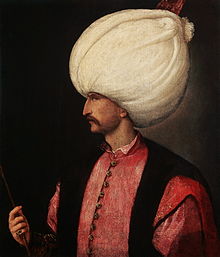
Titian's portrait of Süleymaniye the Magnificent

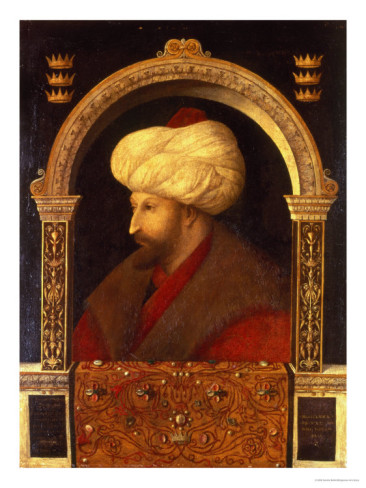
Bellini's portrait of Mehmet II, The Conqueror

Knowing next to nothing about mosques, we decided to visit three of the largest and most admired mosques in a sort of compare and contrast tour. The day was warm and sunny and we set out first for the Sehzade Mosque, built in the 1540s by Süleymaniye the Magnificent to memorialize his beloved 21 year old son who died of smallpox.

The first lesson we learned is that there was very little to contrast. They were all elegant designs, made of pure natural materials in soothing colors, and brightly lit. The arcade surrounding the courtyard entrance . . .
. . . had these red lunettes, each with a different geometric or trailing leaf  pattern.

The interior with a roof composed of domes and semi-domes and pendentives and barrel arches  all emphasised with red terra cotta stripes.
The mihrab, the niche in every mosque, to mark the direction to Mecca for prayer,
A simple letter shape on one of the supporting pillars.

The minaret.

Mosques were not just single buildings, but were more like medieval Christian monasteries with a religious center surrounded by a campus of buildings to support social services like schools, hospitals, kitchens, hostels, baths and water supplies, plus burial grounds and tombs.
On our way to the Fatih Camii, the Conqueror's Mosque we walked along the  Aqueduct of Valens, built in 375 by the Roman Emperor Valens to pipe water from the countryside outside the walls to the giant cisterns in the city.
Along some of the route, houses and mosques are built right up to the aqueduct . . .

. . . in other sections parks are being built alongside. In one, this gilded statue was being erected by workmen.
My original idea was to visit the three mosques chronologically, but Istanbul's long history of earthquakes made that idea unworkable. This is the Conqueror's Mosque, begun in 1463, shortly after Mehmet II entered the city through the gate we saw yesterday. The site chosen was the top of the Fourth Hill, where the once important Church of the Holy Apostles, burial place of Constantine and other Byzantine rulers, had lay in ruins for centuries. The 15th century mosque was hit with so many earthquakes that it had to be rebuilt after the 1766 earthquake finally destroyed it. 
The central dome is a reminder that the Conqueror wanted a mosque to rival Haghia Sophia, and  Judith Herrin in her book Byzantium notes the irony of the basic mosque design being the Christian church of Haghia Sophia.
But a giant scallop shell hints at the Baroque Rococo influence of the age.
On a Sunday afternoon, each of the three mosques were buzzing with activity.  Groups of men, groups of women, families with small children, elderly with adult children wandered through the mosque. A few prayed, most just sat and talked while children ran around playing. 
Today was very warm and bright. After walks up and down hills, we found ourselves in a busy neighbourhood of street markets and cafes. The wonderful Istanbul Eats app I downloaded from a recommendation in a food magazine, netted us a wonderful lunch in the cafe the giant horse in the middle of the square is staring at.

Our last stop was the Süleymaniye Mosque built in the 1550s  and said to be the finest of all Istanbul's mosques by our guidebook. The four minarets indicate just how important this Sultan felt himself to be.
Also built by the great architect Sinan who lived to be 100 years old and was responsible for the design of an astounding number of buildings. The prayer room in each of the three mosques is a cubical box, brightly lit with hanging lamps, grounded with bright carpeting, always clean since shoes are removed before stepping inside and vacuum cleaners seem to always be in use.
The courtyard here was especially elegant with the fountain for ritual cleansing in the center.
And the shade was very welcome on a hot day.
This was the first warm day we can remember since . . . hmmm . . . neither of us could remember since when. So it was very pleasant sit on the hotel's roof terrace, sip some wine, and contemplate the Golden Horn, and be reminded of how much building work and renovation is underway in the city.