Monday, April 1, 2013

Fourth day, Three mosques, Two Sultans

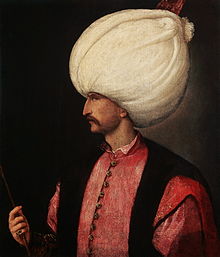
Titian's portrait of Süleymaniye the Magnificent

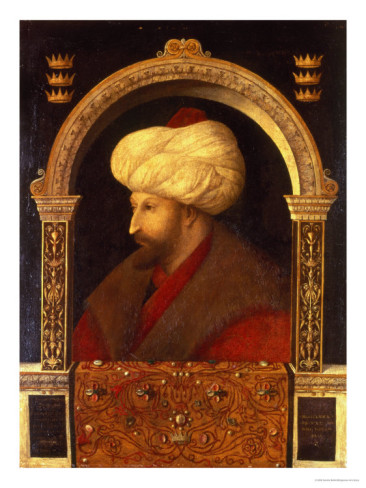
Bellini's portrait of Mehmet II, The Conqueror

Knowing next to nothing about mosques, we decided to visit three of the largest and most admired mosques in a sort of compare and contrast tour. The day was warm and sunny and we set out first for the Sehzade Mosque, built in the 1540s by Süleymaniye the Magnificent to memorialize his beloved 21 year old son who died of smallpox.

The first lesson we learned is that there was very little to contrast. They were all elegant designs, made of pure natural materials in soothing colors, and brightly lit. The arcade surrounding the courtyard entrance . . .
. . . had these red lunettes, each with a different geometric or trailing leaf  pattern.

The interior with a roof composed of domes and semi-domes and pendentives and barrel arches  all emphasised with red terra cotta stripes.
The mihrab, the niche in every mosque, to mark the direction to Mecca for prayer,
A simple letter shape on one of the supporting pillars.

The minaret.

Mosques were not just single buildings, but were more like medieval Christian monasteries with a religious center surrounded by a campus of buildings to support social services like schools, hospitals, kitchens, hostels, baths and water supplies, plus burial grounds and tombs.
On our way to the Fatih Camii, the Conqueror's Mosque we walked along the  Aqueduct of Valens, built in 375 by the Roman Emperor Valens to pipe water from the countryside outside the walls to the giant cisterns in the city.
Along some of the route, houses and mosques are built right up to the aqueduct . . .

. . . in other sections parks are being built alongside. In one, this gilded statue was being erected by workmen.
My original idea was to visit the three mosques chronologically, but Istanbul's long history of earthquakes made that idea unworkable. This is the Conqueror's Mosque, begun in 1463, shortly after Mehmet II entered the city through the gate we saw yesterday. The site chosen was the top of the Fourth Hill, where the once important Church of the Holy Apostles, burial place of Constantine and other Byzantine rulers, had lay in ruins for centuries. The 15th century mosque was hit with so many earthquakes that it had to be rebuilt after the 1766 earthquake finally destroyed it. 
The central dome is a reminder that the Conqueror wanted a mosque to rival Haghia Sophia, and  Judith Herrin in her book Byzantium notes the irony of the basic mosque design being the Christian church of Haghia Sophia.
But a giant scallop shell hints at the Baroque Rococo influence of the age.
On a Sunday afternoon, each of the three mosques were buzzing with activity.  Groups of men, groups of women, families with small children, elderly with adult children wandered through the mosque. A few prayed, most just sat and talked while children ran around playing. 
Today was very warm and bright. After walks up and down hills, we found ourselves in a busy neighbourhood of street markets and cafes. The wonderful Istanbul Eats app I downloaded from a recommendation in a food magazine, netted us a wonderful lunch in the cafe the giant horse in the middle of the square is staring at.

Our last stop was the Süleymaniye Mosque built in the 1550s  and said to be the finest of all Istanbul's mosques by our guidebook. The four minarets indicate just how important this Sultan felt himself to be.
Also built by the great architect Sinan who lived to be 100 years old and was responsible for the design of an astounding number of buildings. The prayer room in each of the three mosques is a cubical box, brightly lit with hanging lamps, grounded with bright carpeting, always clean since shoes are removed before stepping inside and vacuum cleaners seem to always be in use.
The courtyard here was especially elegant with the fountain for ritual cleansing in the center.
And the shade was very welcome on a hot day.
This was the first warm day we can remember since . . . hmmm . . . neither of us could remember since when. So it was very pleasant sit on the hotel's roof terrace, sip some wine, and contemplate the Golden Horn, and be reminded of how much building work and renovation is underway in the city.

Saturday, March 30, 2013

On the third day

The busiest day yet. First we learned to use the excellent tram system which kept us out of the awful weekend traffic, and brought us to the Church of St Saviour in Chora (Kariye Camii). Chora once meant the monastery was outside Constantine's city wall, but when Theodosius built his walls in the 5th century, Chora was inside and close to the walls.  The existing church was built and rebuilt in the 11th, 12th, and 14th centuries.
The narthex and the exonarthex are decorated with mosaics  that date to 1315 to 1321.  Christ Pantocrator in the lunette in the exonarthex over the door into the narthex.
The narthex has a lovely cycle of mosaics relating the life of Mary using stories popular in the 14th century from the Apocryphal Gospel of St. James. Here Mary is cuddled by her devoted parents Joachim and Anne.
A female donor in some way related to the Comnenus dynasty, emperors of Byzantium in its final centuries.  I think she is lovely and reminds me of Gustav Klimt's paintings of women as symbols. We learned last summer on our Klimt tour that his work was influenced by a trip he took to Ravenna to see the Byzantine mosaics.
The naos has lost nearly all its decoration. This part of the church was built in the 11th century
and promptly partially collapsed. The corner piers were added in the 12th century
when the church was rebuilt.
The parecclesion was added as a funeral and tomb chapel and is decorated with
frescoes of death and destruction and of resurrection. 
Nearby the Chora Church is the Edirne Gate in the 5th century walls. On  the 29th of May 1453,
Mehmet II entered  through this gate, ending the 1000 year Byzantine rule of Constantinople.
Mehmet the Conqueror succeeded in capturing the city after  nearly 800 years
of  trying to establish an Islamic capital in Constantinople.

The new era brought new buildings. The Mihrimah Sultan Camii  was built in the 1560s
 for Princess Mihrimah, daughter of Süleyman the Magnificent, by Sinan the greatest mosque builder.The mosque sits at the top of the 6th of Istanbul's Seven Hills. (Every legendary city has to have seven hills.)
The huge interior is flooded with light through the huge windows penetrating every side.
I love the decorative use of colourful stone.
We followed the remains of the wall down to the Golden Horn. 
An ordinary residential neighbourhood where a sunny Saturday afternoon meant
sitting on front stoops watching children play
A sign outside the mosque said it had been damaged in the 1999 earthquake so
 we assumed some of the homes were also shattered then.
Some had access to interesting building materials for a unique wall. 
Gardens flourished
And a tombstone shone bright with gold lettering.
And the view across the Golden Horn was stunning. We walked down to the ferry landing for a boat ride
back to the Galata Bridge and back to our hotel.

Friday, March 29, 2013

What I did in Istanbul on the second day

Today we went to Topkapi Palace. The day was sunny, and the crowds were massive.
The Divan where the Councils of State met. And the divans they must have sat on for their deliberations.
The entrance to the Harem through the Courtyard of the Black Eunuchs
By way of the decorative path
And tile lined walls.
The Sultan's living quarters were in the Harem. Here in the Privy Chamber, a fountain
made enough noise to  prevent eavesdropping on conversations.
The Valide, the Sultan's mother, was the most powerful woman in the Harem,
 and her apartment was sumptuously decorated including the dome in her Salon.
The view toward the water would be spectacular through the grille except for the plastic sheeting
currently covering an area under renovation
The Harem is said to have hundreds of rooms and miles of corridors.
And the words of the Qur'an are always on hand
Most of Topkapi is made up of separate pavilions, or kiosks.
 This is the Sultan's Library.
An especially lovely ceiling decoration in the Library
Looking at Asia across the Bosphorus. Topkapi is located at the point of land
where the Bosphorus and the Golden Horn join at the Marmara Sea.
Looking up the Golden Horn
After leaving Topkapi, we searched for the Mosaic Museum
 and ambled through an old neighbourhood of wooden houses.
A çesme, the public water source for a neighbourhood  
Superb 6th century mosaic floor discovered during 1930s excavations of the Great Palace of Byzantium. 
The floor is housed under a canopy roof that stretches on and on.
They have been restored in recent years to protect them.
And finally, Bob's favourite Green Man, Byzantine style.

Thursday, March 28, 2013

What I did in Istanbul Today

The Golden Horn

The New Mosque (1597-1663) Yeni Cami

The magnificent Byzantine Haghia Sophia (with a few Islamic additions)

The great central dome of Haghia Sophia


The apse from the west Gallery
Treasures of the Archaeological Museum: The Sarcophagus of the Mourning Women (4th c. BC) Sidon


A map of the many layers of occupation at Troy

A stele with a Human Face in Relief, Troy 3000-2500 B.C.
The chain used to close the Golden Horn in times of siege during the Byzantine period
The Tiled Kiosk (Çinili Kösk) built in 1472 by Mehmet The Conquerer
A Peacock Basin in Çinili Kösk