Thursday, July 19, 2012

The summer of culture continues . . . with theatre

Sunday, 8 July


Nothing says London like theatre. In truth that statement should be expanded to the whole of the British Isles, which includes the Republic of Ireland's prodigious contributions. Theatre is deeply embedded in the national character. Elite Ivy League students in the States want to start-up the next Facebook or join the street gang of looters in private equity. Here every Ox-bridge student has a burning ambition to be on the stage. (If that doesn't happen, they will join the Ivy Leaguers on the alternate route of course.)

Maybe it's just having Shakespeare as a native son, but I suspect Shakespeare is the result of the national passion rather than the cause, as the roots of English theatre are very long. More than a few years ago, Bob and I went to York to see the Medieval Mystery Plays the city is working to revive as a regular festival. The plays date to the 14th century when city guilds and confraternities took on a particular Biblical story and using wagons paraded through the city performing the tale at various stops for Corpus Christie. Many other cities had traditional Mystery Play cycles to celebrate various Holy Days. The Reformation put a stop to these Popish spectacles, but York's plays have been revived off and on over the past hundred years. When we saw them, community groups took on the role of the medieval guilds to produce a specific tale. Carts were used to travel to staging areas around the city where the cart would be turned into a set — often a magnificently elaborate set — with a few flips of lids and side panels, and the play would be performed before moving on to the next staging area. This year the pageant is returning to a mid-20th century model with an outdoor theatre set up in a central park on the site of the ruins of York's medieval abbey with an afternoon and an evening showtime lasting throughout August. York is so crowded with tourists in the summer, it will probably be a sell out.

All of this is to admit that we have become very lax in our theatre attendance so far this year. I can't even say what "must sees" we have missed because I haven't even been paying attention. This summer's cultural barrage has given us a chance to make up for our insufficient interest. One of the problems with theatre is that the niche theatres sell out production runs to their dues-paying members and friends before the general public even hears about the season schedule. A second problem is that the "must-see" pre-opening projection occasionally winds up as the "why would you want to waste time on that" post-opening review.  Not a good feeling with the steady rise in the price of tickets over the past few years.

Crow was a collaboration
between illustrator Leonard Baskin
and poet Ted Hughes.
Our first theatre foray does come under this particular cloud. The Greenwich and Docklands International Festival production of a dance and reading performance of Ted Hughes's Crow with the South African Handspring Puppet Company who did the puppetry for War Horse was pegged as a winner. Sadly the initial buzz from the personal theatre bloggers, who are sometimes more accurate than the professionals, all hated it. The professionals said it was a worthy effort, blah, blah, not completely successful, blah, blah taking on too much, blah, blah, blah. We were indebted to the bloggers who said: the theatre is terrible. Yes, that was true. The Greenwich Borough Hall Municipal Auditorium, much like a high school auditorium with a much too small stage area. And they said: who thought a black background behind black puppets (they are crows after all) was a good idea if you want to see anything beyond the third row. So we sat in the front row.

Ted Hughes
Bob and I did not hate it at all. We actually thought it was quite interesting. The dancers/actors were excellent. The puppets were fantastic. Some were figures manipulated by sticks; some were large winged costumes worn by the dancers. The performance lasted about an hour, reduced by a quarter after the first negative previews, which was just about right for sitting through something where my senses were stimulated while my brain had mostly no idea what was going on. The musical score was eerie and wonderful by Leafcutter John, who is apparently well known and well regarded in the electronic music sphere. Spending an evening outside the cultural comfort zone is always illuminating in some way. I still haven't found a way to appreciate modern dance, but I find I am much more intrigued by modern music. And I still wish I could read poetry without my brain clicking off after the second line to wonder what that could possibly mean, and maybe I should check my e-mail now.

Mary Wollstonecraft Shelley
Next we were off to see a production by one of our very favourite theatre companies, Shared Experience, who do plays adapted from the lives and works of writers. One of the gold star most remarkable theatre experiences of a life time was Shared Experience's After Mrs Rochester, a play that conflates the troubled life of Jean Rhys  with the story of Jane Eyre. Rhys wrote the novel The Wide Sargasso Sea, a pre-quel to Jane Eyre with a plot explaining how Mrs Rochester traveled from her birthplace in the West Indies and ended up in the attic somewhere in the Yorkshire moors. Throughout the play, a mad woman lies writhing and moaning on the floor of the stage.

Percy Bysshe Shelley
Nothing could be as good as After Mrs Rochester, but this year's Mary Shelley was excellent. Teenaged Mary, daughter of radical philosopher William Godwin and feminist Mary Wollstonecraft, who died at Mary's birth, runs off with dreamy, and married, poet Percy Bysshe Shelley to live in penury until his title and inheritance come through, and of course to write Frankenstein. The suicide of Mary's elder half-sister Fanny, the issue of Mary Wollstonecraft's dalliance with Gilbert Imlay, an American land speculator who did her wrong. And the dalliance of Mary's younger step-sister Claire (née Jane) Clairmont with Lord Byron who did her wrong are subplots. An interesting family. They are a physical theatre company with a limited cast and short scenes that move very rapidly, so it is easy to get caught up in the constant action on stage. Among the audience was quite a large class of teenage students. When Shelley steals a kiss with Claire Clairmont the entire class of teenaged girls drew in their breath and gasped at once. It was pretty funny.

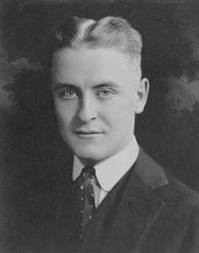
F. Scott Fitzgerald
Finally for a third literary theatre experience, and one that will be added to the gold star list which includes After Mrs Rochester, was the eight hour production of Gatz. The one where The Great Gatsby is read in its entirety over six hours. The extra 2 hours are the intervals and dinner break. As the book is read, by a modern day office clerk trying to get his computer to boot up, the office workers begin to act out the events of the novel using the book's dialogue as their script. The idea suggests the making of a disaster, but not to worry, the performance was riveting, even in an old London theatre without comfortable seats or leg room. A New York theatre company called Elevator Repair Service came up with the idea in 1999 according to the programme notes, but there were copyright issues with the Fitzgerald estate. A few years later, ELS was given rights, and since 2004/2005 Gatz has been playing, first in Europe (but not London), then in the States, in New York in 2010, and now brought to London as part of the London International Festival of Theatre.

Gatsby's Long Island:
North Shore of Nassau County and Queens
I have always had a special place in my heart for The Great Gatsby. When I first read the book, I was in high school on Long Island not far in miles (but very far in family income) from the Eggs, East and West, and not at all far from the Valley of the Ashes which was the site of the 1964 World's Fair when I was reading Gatsby. These were real places. As a teenager I thought Long Island was the worst place in the world, yet here was this famous book, a book everyone was supposed to know and read, and it took place on Long Island. Most great works of literature are read by people much too young and inexperienced to make any sense of what the story is really all about. Perhaps the worst sin is that they are read by people who may not know what is going on but they do know great literature must always be taken seriously.  I have read Gatsby three times, and quite possibly I never laughed once through those readings, but by the first interval of Gatz, that would be 2:05 hours of reading, I discovered The Great Gatsby is a comic novel because I had just laughed my way through the play with the rest of the audience. Yes of course ultimately, we have a tragic tale of obsession and treachery and loss, but getting there is a comedy of manners, the Yalies and the Southern Belles and the hangers-on enabling each others worst qualities. As the reviewers and the programme notes remind us, the similarities between Fitzgerald's 1920s Jazz Age and the pre-financial crisis Noughties are starkly apparent. Our reader/narrator Nick Carraway has come to New York from the boring Midwest to make his fortune as a  bond salesman. That line got a good laugh as you would expect.

Sunday, July 15, 2012

The summer of culture begins . . . with music

Tuesday, 26 June


The Cultural Olympiad began last Thursday. We didn't leap out at the starting gate, but we edged in the next day with a concert from the programme offered by this year's Spitalfields Festival. The Spitalfields Festival was founded decades ago to save Nicholas Hawksmoor's Christ Church, Spitalfields when it was derelict and in real danger of being demolished despite its beauty and historic importance. Christ Church is now in the pristine condition of when it was built nearly 300 years ago.


A few years ago, when Christ Church was closed for building works, the Festival began to hold concerts at the nearby St Leonard's Church, Shoreditch. The current church is only a few year's younger than Spitalfields, designed by another important Georgian architect George Dance the Elder (architecture seems to be a popular family business in England), but there has been a church on the site since Saxon times. According to Wikipedia's entry, Shoreditch was an important centre of Elizabethan theatre, where the first two playhouses were built in 1576 and 1577, so the church has burials and memorials to many famous 16th century pioneers of London's theatre including the Burbages, James who built the first theatre, and employed Shakespeare as a playwright, and his son Richard who starred in many of Shakespeare's plays.

Shakespeare plays a big role in the Cultural Olympiad. Over the summer 37 international Shakespeare companies will be performing all the plays at the reproduction Globe Theatre. So you can hear Shakespeare in Korean (Midsummer Night's Dream), Georgian (As You Like It), Japanese (Cymbeline), Turkish (Antony and Cleopatra), and many other languages. The BBC has produced four of the history plays for TV transmission. Simon Schama is explaining their importance in a TV series. I tried watching one, but I find Schama so patronising and smug, I'm always at a loss as to why he seems to be everywhere these days. There will also be a big exhibition on Shakespeare at the British Museum.  I have been enjoying the podcast of a BBC Radio Four series done by Neil MacGregor, Director of the British Museum, on Shakespeare and his times using artifacts from the Museum. Note to self: stomach Schama and listen to MacGregor's remaining podcast episodes to learn important things about Shakespeare, his time, and his plays.

Back to Shoreditch Church, Friday night, Spitalfields Festival, and a terrific concert by Florilegium, a period instrument group, and a chorus of Bolivian young adults. At about the same time Hawksmoor began working as Christopher Wren's clerk in the 1670s, the Jesuits arrived in Bolivia to convert the native population to Christianity. They established ten missions with the idea of using music to attract converts. They brought along copies of music written in Venice by Corelli, Vivaldi, and Locatelli among others to serve as templates for local musicians to compose suitable work for the missions. The Jesuits were expelled a hundred years later, but the extensive music archives have survived and grown over the centuries. Florilegium's director began exploring Bolivian Baroque ten years ago, founded the choir, and has toured with them for several years. The concert was a mix of Bolivian composers and music brought from Venice in the Bolivian archives.

Now that Spitalfields church is sorted, I hope the Festival will be donating some funding for repair and repainting at Shoreditch too. The venue deserves better than the peeling paint pilasters flanking the altar.

A few nights later we moved on to the City of London Festival for a concert at the other end of the music continuum, Berlioz's Requiem with the London Symphony Orchestra conducted by Sir Colin Davis with a chorus of thousands, well maybe just hundreds, but no one fell asleep during the 90 minutes of  the programme. To top it off we were in St Paul's Cathedral seated under the dome where the famous Whispering Gallery Effect must have been batting the sound back and forth and around like the players at Wimbledon. Then when the horns began blaring from the upper galleries in the transepts the quadraphonic sound circa 1837 is complete. Bob said, if you are going to listen to bombast, it may as well be great bombast. Sitting in St Paul's was a plus too. I haven't been in a very long time, and having an hour and a half to look at the grisaille paintings and lovely mosaics that decorate the dome was a treat.
The grisaille paintings were done by Sir James Thornhill, the most famous painter of interiors for Christopher Wren's projects. The mosaics were not done until the late 19th century however.

This is the painting I was facing, and even after 90 minutes I had no clue to what story it was relating.

Fortunately the website I borrowed this image from has an explanation (and much more). St Paul was shipwrecked off Malta, and when a serpent crawled out of the wreckage, he grabbed it, and did not die, so the locals recognised him as a god (Acts 27).

According to the programme notes, the Requiem was commissioned by the French government in 1837 to commemorate King Louis-Philippe's escape from an assassination attempt on the anniversary of the July Revolution. I boldfaced "escape" because like me you may think a Requiem would be more appropriate for a king who had not escaped an assassination. Go figure. Viva La France and all. As for Louis-Philippe or the July Revolution, I haven't a clue. I have more than enough trouble keeping English
monarchs and uprisings straight to even make a stab at French history.

Wednesday, June 27, 2012

One Amazing Summer

When I left off it was winter, now it is summer, and much has happened in between. And all good things.  Two weddings. One wedding in California where Bob was Best Man. The trip to California, my spiritual home where I met my husband, where my daughters were born, let us connect with so many old friends, many of whom we haven't seen in much too long. (Note to computer start-up son-in-law: Get a job in Silicon Valley, so we can combine trips to see the grandchildren we miss with visits to friends we miss.)

The second wedding was here in London, and Bob and I were Father and Mother of the Bride. So the daughters are sorted then, and well sorted too.

The Queen's Jubilee soon followed, and that was possibly not quite up to the delights of our weddings. There was the soaking rain at the River Pageant. Then our attendance at the local Jubilee Beacon celebration that turned out to be the one Beacon which did not light in the 4000 Beacons that were to unite the country. Shame on you Corporation of London for utilising a complicated electronic switch and not having a back-up plan in place. Poor Isabella chosen to light the Beacon will be in therapy for life. Lighting shouldn't have been more complicated than setting a match to a gas stove burner.

There is of course the very unhappy story of our weather. The wettest, coldest Spring ever recorded according to the weather mavens. The irony being that a mostly dry winter left reservoirs low and water tables uncharged, so the water companies declared a water emergency at the end of March, including a hose pipe ban for garden watering and car washing. On April 1, the skies opened up, and pretty much haven't stopped dripping and dropping water on us since. The water companies have recently reversed the drought emergency allowing people to use their hoses, but really who needs to water a garden totally saturated? Here in London, I am among the many bitching about grey skies, lack of sun, and whether we really do need to put the central heating up a notch even though the calendar says it is June. But the people really suffering are those in areas of the country, north, west, east and south, where floods and gales have caused serious damage.

Now as July approaches, we move into what could, should be One Amazing Summer. The summer is always fun in Hampstead. The locals leave for their second homes in France or Tuscany; the ex-pats head off to their home countries for a season of family and the familiar. Meanwhile the festival season in London bursts with activity for those who stay behind. A vestige of what was once The Season, beginning with the Chelsea Flower Show in May and ending with the races at Goodwood at the end of July. By then the midges in Scotland had completed their short life cycles, allowing everyone who mattered to pile into Scotland to prepare for The Glorious Twelfth when the shooting can begin.

This year we have the Olympics beginning in exactly a month from today. Going along with that the usual London summer festivals of Spitalfields, and the City of London, and the Greenwich and Docklands, and the Proms at the Albert Hall, there is the Cultural Olympiad.
No one is quite sure what that is exactly, but they have issued a 138 page official guide to the London 2012 Festival chock full of events sponsored and scheduled to be held all around the nation not just in London from 21 June to the 9 September. This may make our exhausting 2010 Staycation look like a mere walk in the park.

Let me just add that a country like the UK which has some of the best graphic design in the world has chosen some of the worst graphic design I have ever seen for this Olympics. The logo is repellent. Do I need mention Lisa Simpson? The cover of the Festival brochure is one of the official posters, each one worse than the next. And the mascots have blessedly disappeared since they were unveiled to universal dislike.  I see they have added a lion with an actual face to the mascot line up. Didn't anyone read up on cognitive research that explains people respond to babies and soft toys because they have cute faces with big eyes that trip a biologic response that says nurture me, or in the case of stuffed toys, buy me.

Wednesday, February 1, 2012

A Week in Germany: Saturday (Again)


28. 01. 2012


We woke up to snow this morning. Overnight snow had left a light covering, and the snowfall continued into mid-morning. Not much accumulation, but enough to look very pretty like icing decorating trees and buildings.
Munich's Opera House

An easy tourist schedule for the day, as promised to my doctors, was made possible by Munich’s excellent public transportation network.

First stop was Johanna Daimer’s Felt Shop, a tiny half size space filled with felt in all colours and all possible thicknesses. Megan and I discovered the shop when we were here, back in the day when felt was not a booming area of handcraft and good wool felt was hard to come by. It was Christmas Market, and every woman in Munich was lining up to push their way into the narrow shop to procure whatever local hausfrauen needed for their Christmas decorations. Not that I need any felt at the moment, but I wanted to make a tribute return visit. And their little packets of felt cutouts are very charming.

We followed the felt pilgrimage with "the best Wienerschnitzel in Munich" according to a 2010 article in The Guardian. And it was indeed superb, made with white veal, so principles had to be tossed out the same window used for French foie gras meals, but it really beats the pork or pink veal versions. The price has increased slightly to 24 euros.

Another thing I love about Germany is that you can eat meals when you are hungry.  No waiting until 12:30 or 7:00 p.m. for lunch and dinner as you must in London in their effort to be continental. The worst is having to wait until 10 p.m. for dinner in Spain! My scheduling for the morning took less time than expected, so we turned up at the restaurant shortly after 11:00, and there were people already eating. Since we had eaten little breakfast, we were ready for lunch, and by the time we left at 12:30, the restaurant was heaving.

The next thing to love about Munich is Bus Line 100, called the Museum Line, that does a loop around the major museums on the north side of the city. When we were looking at what Munich had to offer, Bob had seen a brochure for Villa Stuck, an Art Nouveau house museum, and said that was his first choice for an outing. From the restaurant we easily found the bus which dropped us right in front of the Villa, in an outer residential neighbourhood of the city. The ride took us through beautiful snow covered park lands along the banks of the River Isar.  (I forgot my camera, but Bob was able to take a few photos.)
The monument is the Friedensengel, or Angel of Peace, unveiled in 1899
to commemorate the 25 years of peace after the Franco-German Wars of the 1870s.  
The Villa Stuck was fantastic in every sense of the word. Over-decorated, over-gilded, over-dramatic, and utterly beautiful.  Franz Stuck — he became Franz Ritter von Stuck when he was knighted — was a leading artist of the German Jugendstil wing of the Art Nouveau movement, and his house with its Gold Medal winning (Chicago 1893; Paris 1900) furniture and decoration is his masterpiece. He was also a professor of art, who counted Paul Klee as one of his students, and he is said to have described the Villa as “frighteningly wonderful.” Sadly I have no interior photos, and I can't find any links that include photos, so I admit to brazenly lifting images from Google here.
Bob took this one of the exterior
Music Salon

The Museum also has additional gallery space that hosts exhibitions of work from the period around  1900. The current exhibit features French artist Jules Chéret who is known as the father of the modern poster for his work advertising cabarets and musical performances. He was also a painter, illustrator, designer, and decorator. A previously unknown artist to us, but his poster work is  clearly the foundation for work by artists whose names are very familiar. The link to the exhibit includes a slide show of some of the work on display, although the text is in German.

After a wander through the museum, it was time to rest my leg again, and Bus 100 took us across the city to the Railroad Station where our hotel is nearby. On the way we passed the many other museums we will have to save for a next visit.

And tomorrow we fly back to London.


A Week in Germany: Friday


27. 01. 2012


Today has sped by. I slept. I read. I knit. I sent e-mails. I read e-mails.

I watched 5 minutes of TV, but the only English language channels are BBC World (boring); CNBC (more boring); and Bloomberg (totally boring).

However the Abu Dhabi Channel had camel racing—LIVE camel racing according to the screen caption.

Bob brought me breakfast and lunch and snack food before he left this morning. I can recommend “Kinder Schoko-Bons … für die Extra-Portion Milch.” I’m sure even non-German readers can parse that one out, and recognize the advice I’m sure all good mothers appreciate.

The swelling is going down on the foot which looked so plump and smooth, like a baby foot, or more likely, a foot pumped up with Botox. The purple discolouration is not quite as purple now. Perhaps some holiday activity can resume tomorrow.

That's not my leg, but Duke Henry the Lion, sovereign ruler of Lower Saxony and Bavaria, and the founder of Munich in 1158 as a market city to help him gain control of the Southern German salt road from Bishop Otto I of Freising. Frederick Barbarossa settled the dispute by assigning the route to Henry, but some of the revenue to Otto. (All cribbed from the City Museum's exhibition guide.)


Here is Henry in full splendour.


A Week in Germany: Thursday


26. 01. 2012


The trip has taken a unfortunate turn in the excellent city of Munich which I have visited several times before and have in mind a list of places for a bit of shopping. However, more on that later because the day began bright and sunny.

I love the tabletop Christmas tree
Breakfast in a marquis café in the Viktuallen Market with homemade Apple Cake with Whipped Cream. Then Bob went off to a meeting while I went to the Radspieler a design and textile shop Megan and I discovered when we were here in 2005 for the Christmas Market. In business since 1841, and someday I will go back and buy meters and meters of furnishing fabric and dirndl fabric. But it is the kind of shop that has so many beautiful things, I am hard pressed to decide what I can’t live without, then decide I can’t decide, and leave with the smallest item in hand. So a money saver in the end.

Met up with Bob at the nearby Assam Church which is so gold encrusted that it is headache inducing.

Followed by an excellent lunch of Potato Soup and Liverwurst with raw onions and pickles, accompanied by the winter brewed “starkbier” or strong beer because in the winter a nourishing beer was needed as an antidote to the cold.


Bob had a free afternoon so we headed to the Munich City Museum to learn more about the city from a special permanent exhibit done a few years ago to celebrate the city’s 800th anniversary. An excellent little booklet in English was on hand to explain the history and the artefacts on display. I find Germany so confusing since it was divided into autonomous states well into the 19th century, everywhere you travel, the guidebooks are discussing new sets of princes and kings, electors and dukes. There are paintings of endless royals who were patrons of the highest arts, but there is no way to fit them into a coherent framework.

The section on poster art of the early 20th century was most interesting. We knew our favourite poster artist E. McKnight Kauffer had studied in Germany before coming to London in 1914 when war was declared, and here we could see the work that influenced him.

We had reached maximum absorption capability when we discovered the museum also housed a huge and fascinating collection on the history of puppets, really marionettes, and amusement parks.
The beast . . .
. . . and the beauty
The city history exhibit pulls no punches in the difficult mid-20th century history stating clearly that Munich is responsible for Hitler’s rise to power, but the exhibition itself seemed a bit disjointed unlike the displays in earlier galleries. As we were leaving the museum, we realized the Nazi era display had been given a special exhibition space with a separate entrance, but we were just too tired to face any more information.


When we arrived back at the hotel, I discovered I was perhaps tired because the lower leg, foot, and ankle attached to the knee I had injured last Sunday, and which seemed to be healing, was very swollen and had turned a not very healthy colour of bright purple. So we learned the location of the nearest hospital from the hotel and took a cab to investigate the German health system.

The hospital seemed to be some sort of huge university complex. The emergency room I went to, as directed by the very helpful cab driver, had only one other patient in the three hours I was there. I was attended by a cast of movie star handsome doctor, medical student (who had spent a year doing research in Boston), and radiologist, and that was just the men. Between their English and my occasional brain flashes of high school German returning in puffs of memory, we were able to convey our information back and forth.

Fortunately they found nothing to be wrong in the way of blood clots, thrombosis, arterial damage, and whatever else they looked for in the sonogram and blood tests and EKG. Eventually they wrapped my leg in a compression bandage and told me to keep my foot elevated and not to walk around for a day to see if the swelling would go down.

So now I am to look forward to a day in a hotel room. Thankfully this hotel offers free internet, and The Pickwick Papers on my Kindle will last through the next few months, and I am way behind on the cushion cover that I am knitting for the Olympic athlete donation scheme.


Tuesday, January 31, 2012

A Week in Germany: Wednesday


25. 01. 2012


Here  I am back on the train again. This time the destination is Munich. We are pulling out of the Nürnberg station as I type. Next stop Munich in an hour. Bob is on another train somewhere out there. The travel agency used by the bank did his tickets; then I purchased mine on the same trains. Except for this ticket. I could not find his train on the Deutschebahn schedule. When I queried him, he queried them, and they said the time and number of his train had been “changed” by DB since his tickets were booked. Sounded fishy to me. And sure enough while we were standing on the platform, we discovered there were in fact two trains to Munich leaving four minutes apart. I think I got the better train since I arrive 20 minutes before he does.

Last night was spent in Frankfurt, leaving me with most of a day on my own here. With no particular plans I headed towards the Goethe House Museum. The street map indicated a winding greenway connecting the New Opera House and the Old Opera House that would lead me eventually to the city centre. The walk was kept interesting by some public sculpture.
Where there is a Goethe, there is always a Schiller
These ladies looked uncomfortable without their bathwater
Not a clue what it means, but very eye catching

Frankfurt's Old Opera was destroyed in a bombing raid. A New Opera was built in the early 1950s, and the Old Opera was left as a ruin until the 1960s when plans were made to raze what was left for an office development. The citizens rallied, raised funds, and an exact replica of the beloved Old Opera opened in 1981.


The Goethe House Museum proved to be a wonderful treat that kept me occupied for hours. Four floors of beautifully appointed rooms, filled with interesting objects and art. Visitors are allowed to walk around on their own at their own pace, so no annoying tours and very few ropes to get in the way.
The exhibit about Goethe and his family is very well done, and in English along with German.
The house was originally a medieval half-timbered structure, but Papa Johann
 used some of his inheritance to update to a modern style

Goethe was born in the house in 1749 and looks to have had an ideal childhood immersed in the social and cultural life of the city. His paternal grandfather had made a fortune by marrying a widow with a brewery. Papa Johann lived off his parents' money in this fantastically beautiful house and occupied his time buying paintings from local artists and collecting books. He had the good sense to marry a daughter from one of the town’s leading families, thus acquiring social standing to add to the lustre of inherited wealth.
The back entrance used to enter the house

The lovely puppet theatre little Johann received when he was 4 years old is on display and between dreaming up plays for his puppets and reading his father’s science book collection, his career path was established early. Papa Johann however wanted his son to become a working lawyer, but whenever he was sent off to study the law, he preferred the company of writers, painters, and philosophers, so father-son relations became strained.
An astronomical clock built by a local craftsman
According to the guidebook, the bear falls
over when the clock needs rewinding. 
Papa's Library that held his collection of 2,000 books.
The all important puppet theatre
Along with the house, the Museum also has a collection of paintings of the period. Not exceptional art, but interesting as a background to the artistic developments of the time with Sense and Sensibility and Sturm und Drang all the rage among aesthetes resisting the pull of Classicism. The paintings aren’t all mediocre as there are three Casper David Friedrich’s, including a small moonlight with swans that is mesmerizing.

The general wisdom is that Frankfurt is not very interesting for exploring, but I have had a good time without making much of an effort to investigate what's on offer. I just found a website Frankfurt on Foot that has a great walking tour of the city and a great blog filled with ideas for visitors and expats that I will turn to next time I am in Frankfurt.

I arrived in Munich a few minutes ahead of schedule, but Bob’s train took a different route and arrived 45 minutes later. Fortunately our hotel is right next to the train station, and we were able to have an excellent bite to eat and some local beer in the buzzing bar. I'm so glad to be back in Munich, one of my favourite cities.