Tuesday, September 21, 2010

The North: Tuesday

14 September 2010
We arrived too late on Monday to see the museum displays at Durham Cathedral, so we spent the morning in the fantastic Treasury where St Cuthbert's coffin, is kept, and in the Monk's Dormitory where a display of carved Saxon crosses can be found with interesting casts of famous crosses and wonderful carved pieces of stone collected by antiquarians dismayed at losing examples of this early art form.

 Durham gave us a rainbow in fact and a pot of gold in metaphor when Bob got the call just as we were leaving the Palace Green to head north to the holy sites of Saxon Christianity that the contract for his new job was in the mail, ready to be signed. 

Christianity was brought to England with the Romans as one of many religious sects gaining popularity as the Empire both grew to encompass a broad range of cultural influences and began its decline. When the Romans abandoned Britain c. 410, a truly Dark Age began and Christianity might have have petered out except for the missionary work of St Patrick. Patrick was a Roman-Britain, probably
born in the area of Hadrian's Wall which is now the northernmost English counties of Northumberland and Cumbria, who lived during the 5th century when Rome withdrew its troops. He was abducted as a child and taken to Ireland where he lived for several years before returning to Britain and becoming a Christian. He returned to Ireland and through his missionary work converted the Irish to Christianity.

During the 6th century, Britain was re-Christianised from two directions. In 563, the monastery of Iona, an island off the west coast of Scotland, was founded by the exiled Irish monk Columba and a small band of his followers. A few years later in 597, Pope Gregory I sent the monk Augustine to Britain to convert the locals to Christianity. By this time the locals were Saxons who had emigrated from Denmark and northern Germany and taken over from the native Britains who were now pushed into the western provinces of Wales and Cornwall. Theories on why the Saxons moved in include the lure of rich agricultural land or by invitation as mercenaries helping the local warlords in what was undoubtedly a century of upheaval.

Augustine was successful in winning over the Kentish king who was married to a Christian Frankish princess. Augustine set up a monastery in the former Roman city at Canterbury which of course remains the headquarters of the Church of England. In the north, Iona's monastery sent Aidan to the east coast of Northumbria to establish a monastery on the island of Lindisfarne in 635. Cuthbert, whose shrine is in Durham Cathedral, became a legendary leader of the Lindisfarne community. Christianity spread through Saxon Britain, but differences of worship and practice arose between the Iona communities and the Roman communities leading to a crucial Synod held in 664 at Whitby Abbey in North Yorkshire where a decision was made by the Northumbrian king to follow the Roman tradition after both sides were given a chance to present their case.

In the years after Whitby, two important church and monastery communities were founded in what was then Northumbria. Benedict Biscop founded St Peter's in Monkwearmouth in 674. Biscop was an ardent supporter of Rome making six times to the city, bringing back books and art treasures for his foundation.
The Saxon Tower at Monkwearmouth
The remaining Saxon wall with tiny windows
The portal in the Saxon wall
Saxon carvings in the exterior porch
A Saxon dragon carving found during an excavation

In 681, Biscop sent a group of his monks to Jarrow, a few miles north, to found the companion church and monastery of St Paul's. At the age of eight, the Venerable Bede entered Jarrow and remained part of the foundation until his death in 735.Much of what we know about this period, making it not such a Dark Age, is from Bede's prolific writing, especially his History of the English Church.
The Norman portal at Jarrow
The small Saxon church was attached to the rebuilt
Norman church to be used as the chancel
The exterior entry of the Saxon church with
the original 685 dedication stone above the arch
The dedication stone
Next to St Paul's in Jarrow is Bede's World, an educational centre with informative displays about the period and the place and Bede's contributions to early Christian scholarship, including the formula to determine the date of Easter (the first Sunday after the first full moon after the Spring Equinox, if you are wondering), perhaps the most important issue dividing the Iona and the Roman churches before Whitby. Since the Crucifixion and the Resurrection are what it's all about, coming up with different dates by means of different calculation, just wasn't on. Bede's World is also putting together a living history Saxon farmstead as another part of the exhibition. All of this will be given much greater status if UNESCO agrees to accept the UK's 2010 nomination of the Twin Monasteries as a World Heritage Site next year.
The Saxon farm reconstruction

To continue the tale of the Golden Age of Saxon Christianity, the era ended abruptly when the Vikings began their invasions in the 9th century. At Lindisfarne, Cuthbert had died in 687, but when his coffin was opened a decade later, his body was found to be miraculously uncorrupted. In 875, when the Vikings destroyed Lindisfarne, the monks picked up Cuthbert's coffin and carried it about with them for 120 years until, the legend says, they followed a cow who sat down in a field on an ox-bow in the Wear River, and that was a sign to build Cuthbert's shrine. After the Norman's arrived they co-opted the local Saint Cuthbert, as clever victors do, and built Durham Cathedral to honour him with the magnificent shrine where his body was interred in 1104. And yes, that same coffin is my favourite treasure in the Cathedral's museum. The sides and top are carved with primitive angels and evangelists, with Christ in Majesty and as a baby being held by his mother, the earliest depiction in Western art.

The Golden Age of Saxon Christianity in the North produced the greatest works of art of those Dark Ages: illuminated manuscripts such as the Lindisfarne Gospels and the carved Saxon crosses. The influence of Saxon Christianity was a crucial in the revival of learning in Western Europe. The brief pit stop in the quick tour of Western history between Rome and the Conquest is always the Carolingian Renaissance. Charlemagne's favourite scholar Alcuin was educated in York under a bishop who had been a student of Bede's at Jarrow. But the Golden Age was already coming to an end. In 793, the first Viking attack on Lindisfarne was met with shock. Alcuin wrote at the time, "Never before has such terror appeared in Britain as we have now suffered from a pagan race. . . .The heathens poured out the blood of saints around the altar, and trampled on the bodies of saints in the temple of God, like dung in the streets." The Viking invaders also plundered the monasteries at Monkwearmoth and Jarrow, and they were abandoned for two centuries. In the 12th century, the Normans, the tamed Vikings of France, rebuilt the churches and revived the monastic foundations as their own.


The North: Monday

The UNESCO World Heritage Site Marker
13 September 2010
London can't be beaten as a place for a staycation, but having time on our hands still, we decided to use the opportunity to revisit some favourite places in the north of England. Monday morning we took off for The North, as the motorway signage describes it on route signs — along with The South and The West — I'm not sure I have ever seen The East on a sign though. The most important companion volumes on our travels are our two pub guides (CAMRA and Michelin) and our 1000 Best Churches book. On this trip, Bob hauled along a pile of works about the Saxons. He has been reading books about early Christianity in Northern Europe and about  illuminated manuscripts for the past few years. Our plan was to visit Saxon sites, some we have never seen, others we visited years ago when we knew much less about early medieval history.

The so-called Dark Ages were passed over quickly when we studied high school World History in the early 1960s. As I remember it, there was a farewell to Rome, followed by hello Norman Conquest with a mention that not much happened in between. 650 years! That would be from the stirrings of the Renaissance to the present day in the measurement of years. Of course a great deal happened, but what that would be is still mostly a mystery. Recent finds like the Staffordshire Hoard are greeted with such excitement because every artifact offers a few more clues to the puzzle. Fortunately those 600 years aren't quite as Dark as they once were deemed to be with much of the information coming from Christian sources.

We arrived in Durham by mid-afternoon. I first went to Durham because of Bill Bryson. Before Megan and I spent the summer of 1997 traveling in England, I read Bryson's Notes on a Small Island in which he visits Durham and finds it to be a lovely spot that is totally ignored and avoided by all citizens of this country. In the years since moving to London, I have regularly asked people if they have ever been to Durham, and invariably the answer is no. Durham does have a large, highly regarded university, so there must be some regular movement in and out of the city from across the country. Bill Bryson has been rewarded by being made Chancellor of Durham University. (The Chancellor is a ceremonial role in the UK; the actual work is done by the Vice Chancellor.) And this is my third trip to Durham which finally has a decent restaurant — organic, local sourcing  — so visitors are not limited to fish-and-chips or tikka masala any longer.

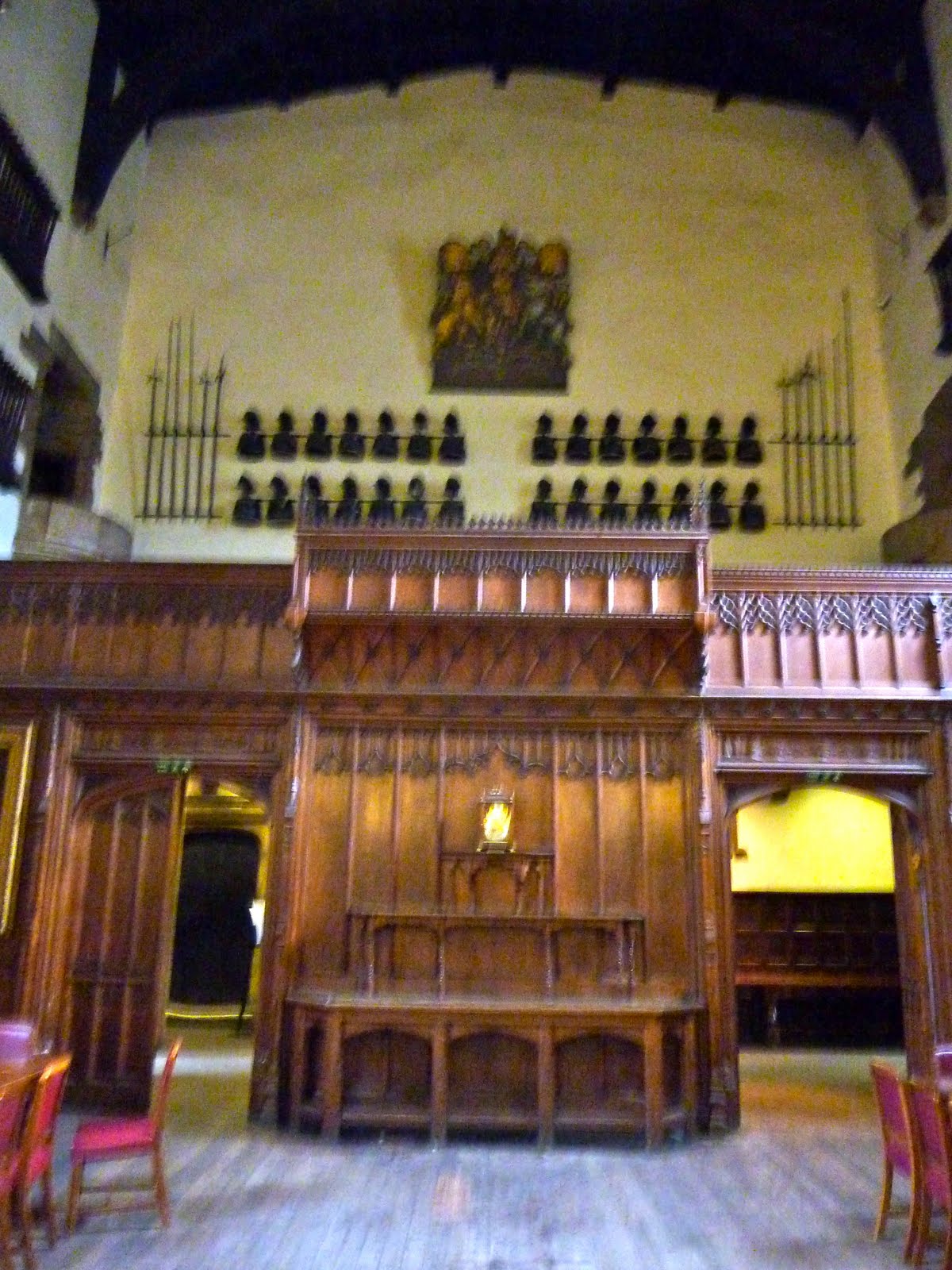
Accommodation is still bleak except during university holidays, when cheap rooms can be rented in the dorms. The original university college is housed in the Norman Castle that faces the Cathedral across the Palace Green. So we booked into the Castle, and were assigned a room at the top of a stairwell tower with the loo two or three flights below! It's cheap and clean, the beds are comfortable, and breakfast is served in the 14th century Great Hall, and the largest in England at the time, so no complaints from here.
Palace Green and Entrance to Durham Castle
Norman Portal to the Castle
Detail of Portal carving
The Castle Bailey with the Motte on the embanked rise
The Pelican, a medieval symbol of charity, in the entrance to our tower
The ancient timber roof supports in our room
The 14th c. Great Hall set for our breakfast
The Hall's Gallery. No entertaining minstrels at breakfast though

Durham Cathedral is my favourite cathedral. The cathedral and castle are set high on the tip of an ox-bow in the River Wear, so they seem to be surrounded by water. During the 19th century the peninsula was planted with trees and ringed with high and low paths that circle the buildings offering gorgeous vistas in all directions.

Over the River Wear 
Up the steep pavement
And the Cathedral appears
With its Door Knocker offering Sanctuary to all who knock
This is a replica of the original displayed in the Cathedral Museum

A strict no photography rule is imposed in the Cathedral which is sad because Durham is my favourite cathedral with its massive carved piers. This picture is borrowed from Google images.

The original cathedral is pure Romanesque, but extensions over the next few centuries have added Gothic embellishment to the interior and exterior. The most famous additions are the Galilee Porch at the west end where the Venerable Bede is buried and the Gothic Chapel of the Nine Altars at the east end where the pilgrimage Shrine of St Cuthbert was built to house his bones 400 years after his death.

Sunday, September 12, 2010

Another Treasure House

Today we did something we almost never do. We drove someplace in London. I never think of using a car when I am plotting out these local trips, but today's destination looked so difficult I said to Bob, "Let's use the car." He always grimaces a bit, because he has to do the driving. (Have I mentioned that I have never driven in this country since I moved here.) And I understand his lack of enthusiasm because this city was never designed for cars, and modern day traffic planners have made such a hash of setting lights and crossings, and adding parking lanes and bus lanes, and now bike lanes to streets that can barely accommodate two cars going in opposite directions without one stopping and letting the other squeeze by (the infamous "rat runs"). Yet somehow the natives think none of this is a problem and seem to blithely drive nearly everywhere. So today we drove to Wimbledon Common, a distance of 12 miles according to Google mapping, and it hardly took us more than an hour to get there.

We met Susan and Cato at the Windmill on Wimbledon Common for a picnic lunch of Nigella's Cornish Pasties prepared by Susan. We brought the wine and the brownies bought at the River Festival yesterday.

Then we walked along the Capital Ring path to Kingston-on-Thames for the real destination of the day, another one of those tiny gems in an odd corner of London discovered by Susan who booked us in for a tour this afternoon, on the one weekend a month the house is open to the public.

Dora Gordine was a Latvian sculptor, trained in Paris, who married an English aristocrat Richard Hare, a younger son of the Earl of Listowel, and together they designed a house around studio and exhibition space for Dora's bronze sculpture and paintings, and for Richard's collection of Russian art. They called the house by the portmanteau Dorich House, and Dora lived there from 1936 until she died in 1992 as she approached her centenary. The House is now owned by Kingston University, who have lovingly restored the rooms to the elegant level of Dora and Richard's original design.

I'm afraid my photography was off today, and my photos really do not do justice to the house.
The exterior which is much nicer than this photo indicates
Dora's Bronzes on display in the Gallery
More wonderful Gallery windows
The elegant dining room
With sliding moon doors
An original Bloomsbury fabric curtain
Susan and Cato (antiqued on i-photo) coveting (along with everyone else) the fabulous roof garden
We walked back to Wimbledon Common and went to the Windmill Museum which was also a fascinating little place filled with models of English windmills, and exhibits on traditional English milling.

Then it was a drive home which only took about 90 minutes to do the full 12 miles.

Another Day, Same River

Autumn is only a week away. The days are markedly shorter, both morning and evening have shifted. Thankfully in the mornings away from the 4:30 a.m. wake-up shafts of light peeking through windows. The newspaper supplements are full of lists of the must-see events for the next few months as the autumn cultural season opens a new year. We have remembered to book seats for our favourite Christmas concert. And I have booked my tickets for six weeks in Massachusetts to welcome a new granddaughter to be born shortly before Halloween.

Locally, there are festivals everywhere. One of our local bakeries has a food festival in Hampstead every year, so we started the day there. Sipping fortified wine and nibbling chocolate samples before breakfast is always a good way to start a day. The predicted rain, once again, never arrived, and the day turned into beautiful blue skies with a brisk wind.

Then we moved on to the Thames Festival, an annual weekend event in September that has grown year by year.  Bob is a great boat lover so we headed out to St Katharine Docks for a display of vintage boats.
This cockle boat participated in the Dunkirk Rescue
Then we headed across Tower Bridge for the  information booths soliciting interest in environmental projects and organisations working to protect the river.
An impromptu Morris Dance at London's riverside City Hall.

Finally we crossed Southwark Bridge which was traffic free to allow a community harvest festival with long tables set up for sharing meals, and autumn harvest activities with pumpkins and straw.


We were pretty tired by this time, so we never made farther it to the other festival venues farther up the river at the Tate Modern and the Southbank Centre.  It felt good to get home, put my feet up, and find out the opening episode of the new season of Mad Men was on, perfect for getting a little knitting done.

Saturday, September 11, 2010

Susan has started a new job at the Greenwich Heritage Centre which is the local museum and archive for the Borough of Greenwich. The Heritage Centre is located in Woolwich in what was once the Royal Dockyards and Arsenal. When we walked the Capital Ring, the 70+ mile signposted path that runs through  a corridor of parks and greenways around the city, we had walked through the Royal Arsenal, but had no time to stop and explore. Susan's new job gave us a good reason to plan an excursion to the eastern end of the Thames Path to see the Thames Flood Barrier.

We began our walk at the North Greenwich Tube Station where the infamous Millennium Dome is to be found. From the worst public exhibition ever slapped together ten years ago, through years of redundancy, the Dome is now the highly successful O-2 concert venue.
This end of the river is not all beautiful. Yacht clubs and high rise flats mix with warehouses and working piers. Aggregate stone for construction is loaded onto a barge at this pier.


Along the way, the Greenwich Ecology Centre provided a lovely view of the natural river with a boardwalk and bird hides.


On our Capital Ring Walk from Woolwich last spring, we did not detour to visit the Thames Barrier because, sadly, the Thames Path has a major diversion away from the river to a very unpleasant busy road just to the east of the Barrier.  The Barrier looms out of the water like some sort of giant art installation of silver helmets.


The Thames Barrier was completed in 1982 to prevent tidal surges — the Thames is a tidal estuary through London — from swamping the city when storm surges are forced up the river from the North Sea. When a surge is predicted the Barrier's gates rotate into place to hold the incoming tide back. This will work until rising sea level caused by global warming requires a taller barrier. And it doesn't offer much help to the river dwellers to the east of the Barrier.
Looking back to the Millennium Dome and Canary Wharf
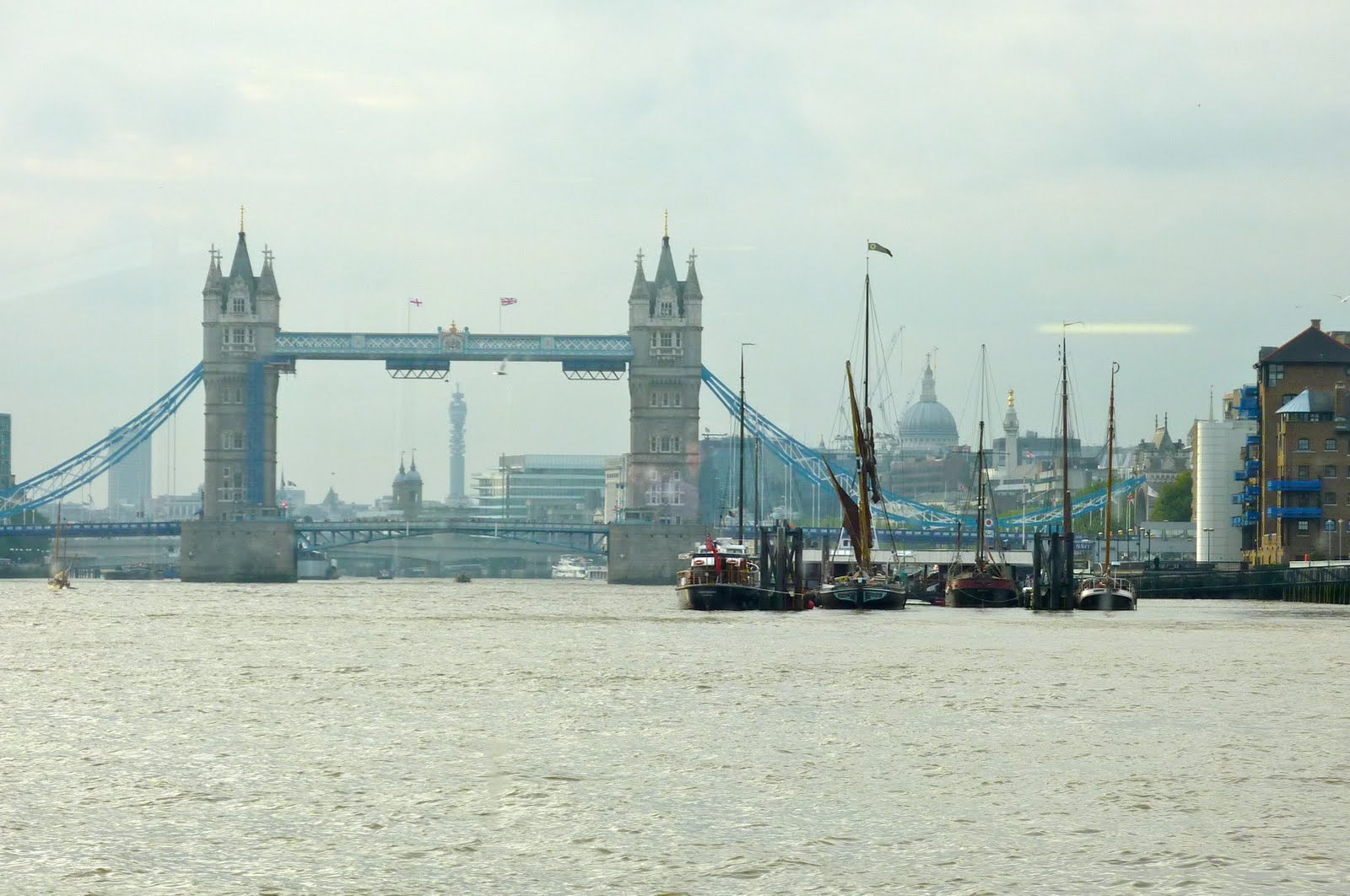
The unprotected side of the Barrier. The navigation channels are spaced to the same size as  Tower Bridge, the entry point into the Pool of London.
To avoid the unpleasant road, we took the bus into Woolwich where we met Susan at the Royal Arsenal
for lunch.  Woolwich has had a long connection with the military since Henry VIII chose the spot to build his warships at the Royal Dockyards. The Royal Navy that ruled the world was the product of that Dockyard. When guns and ammunition and bombs became the preferred weapons of war, a dedicated metal working facility was needed to ensure quality production of armaments, and Woolwich Arsenal was founded in the late 17th century. War was a growth industry and the Arsenal employed up to 80,000 workers during the war years of the 20th century. In the late 1960s the Arsenal closed, however the site remained in military use until the 1990s. It is now being rehabbed for mixed use residential, office and commercial space, with a few cultural amenities too.

At lunch, Susan mentioned one of the new commuter boat services being encouraged by the Mayor, stopped at the Royal Arsenal pier, so we thought a boat trip back to central London would top off the day. We wended our way through a public sculpture at the pier entrance.

And discovered the boat comes out to Woolwich only during commuter rush hours, so we hopped a bus back to North Greenwich where the boat leaves every 20 minutes.
Our boat was one of the ones painted with Damian Hirst dots  by the Tate.
Entering London through Tower Bridge.

And we were back home in time to meet friends for dinner at the gastropub at the end of our street.

Friday, September 10, 2010

Connecting the Dots

A big day for a lot of people I know and love.
And I know these things because of Facebook. 

The best post of the day was a picture of Bibs ready for her first day of pre-school at the local Montessori School.

She is so lovely in the hand smocked dress — embroidered with nearly a 1000 bullions — that Megan sewed especially for the first day. I lifted Megan's photo from Facebook, so it seems to be a bit fuzzy.

Then there was a link to a newsletter produced by Andy Tuohy, who is Megan's husband's aunt's partner (personal and business) and a hugely talented graphic artist producing updated versions of the wonderful travel posters England was noted for during the mid-20th century.

Then my son-in-law posted a link from an article in The Economist, no less, which opens with a reference to Swipely, the start-up company he is working for. The writer begins his piece voicing the same appalled reaction that everyone I have ever explained the concept to has had. Nevertheless, keep in mind what Bob said when we signed up to Swipely in a show a family support, "Ten years ago who would have thought that most of the things we buy, we buy on line."

And I can add to that, five years ago I would have never thought I would join Facebook. And now it is often the first site I check in the morning. In addition to people who are part of my life today, I have re-connected with people who were very important parts of my life in years past. I am even in touch with high school friends who disappeared from my life 44 years ago. Another of today's messages was about a group of high school classmates meeting for lunch yesterday in the Hudson Valley where they all now live. For someone like me whose life was lived in a straight line trajectory, rarely looking back, it is comforting to start thinking about life as a circle with connections backwards and forwards.

Our children have created that sort of world of connectedness for themselves through social networking. When I see comments on Megan's Facebook posts I recognise names from her primary school in New Jersey, her summer camp in Maine, her high school in Boston, her college in Ohio, blended in with the comments of her adult friends today. The connections are always there, on hand, ready to make sense of life as it moves forward. I know that my generation of Baby Boomers created the internet, but we didn't have the nous to make it the life changer that our kids have embraced.

This is how the Internet has changed my life in the 12 years I have lived in London:
First was e-mailing: which I use nearly exclusively to communicate with people
Second was shopping: first for books, then for items from the States not available here, then for clothes, then for household items and for food and wine and beer
Third was news: all points of view available from crazy right to crazy left, with the assurance of calming comment somewhere on the center left
Fourth for Facebook: to keep up with what's happening in real time
Fifth for the BBC i-player: which lets me watch what I missed, like the start of Mad Men Season 4 last night, without feeling bereft at missing things I want to watch

So who's to say that I won't be happily swiping with Swipely in the future, so that my Swipely friends can chide me — from around the world — for buying yet more unneeded fabric or yarn to add to the stash.


Monday, September 6, 2010

Marathon Knitting

I have only been gone for a week, but there have been requests for me to pick up the pace here even though our staycation is only a summer memory.

I am in London, but the wide range of London travels last month was replaced this past week with the very narrow limits of one arm chair in front of the TV while I knit. Sometimes the only way to face the world is with yarn and needles. Whatever is ailing you disappears as the alpha waves take over and the rows of stitches pile up. All very Zen, I guess, but sometimes a knitting marathon can bring forth a finished product, as this one did.

A new sweater for my granddaughter.

I used Elizabeth Zimmermann's legendary Baby Surprise sweater pattern that is knitted all in one piece. I made one last summer for the first time in a baby size, and it was such fun, I wanted to do another one. When we were visiting friends in New Hampshire this summer we stopped off at the huge Patternworks yarn shop in Centre Harbor where I bought some random skeins of thick soft merino in bright colours that were on sale. As usual when I buy yarn that appeals to me, there was no preconceived plan for the yarn which explains my humungous stash of yarn, all waiting to be assigned a plan and a pattern.

With the thicker yarn and a larger needle, I hoped the Baby Surprise would come out as a Little Girl Surprise, and I think it has. There were a few tense moments when I thought I would run out of yarn in the final rounds of knitting, but I managed to eke out the last few stripes.
Leftover yarn!

I also learned a new technique. I used Elizabeth Zimmermann's I-cord edging for the neck. I love the look and can't wait to try it on other edges.

Today I went out in search of buttons which is always a lost cause here in London. Oh for a Joanne's Fabrics when buttons are required. There are a fair number of outlets for fancy buttons, but basic plastic in a broad range of colours and sizes are impossible to come by as far as I can tell. I went to the famous Button Queen on Marylebone Lane who did have bright colours, although not in a large size, and not six in the same colour either.

After three days in the same chair, last night I managed to rouse myself to go to the South Bank for a concert by The Imagined Village, made up of folk musicians who formed this collective group a few years ago to explore what English folk music is. Their idea is to present folk music in both traditional and new ways with a multicultural bent that represents the folk of modern Britain. I asked Bob what he would call what they do, and he said "folk fusion." So that's the best I can do to describe them.

Except for the Prom concert we went to in August, we hadn't been to a concert in months and months which is very out of character for Bob who lives for music of all kinds. Now that September is here, the seasonal schedules for every concert hall and performing group are piling up. Not to mention the newspaper and magazine supplements on what not to miss this season. It is one of the things I love about September in London.